10 Common Mistakes in Cambodian Real Estate Investment –and 7 Proven Ways to Avoid Them
Author: Anna Araki / Anna Advisors Inc.

You may have heard people say things like:
“If you invest in a Cambodian condominium, you’ll make a killing.”
“You can get double-digit yields.”
Cambodian real estate certainly has strong upside, but that doesn’t mean every investment succeeds.
In fact, there are plenty of real-world failure cases.
In this article, we’ll walk through:
- 10 actual failure examples in Cambodian real estate investment
- 7 practical strategies to avoid making the same mistakes
If you’re interested in Cambodian property—or you simply don’t want to fail in overseas real estate—read on.
Table of Contents
- What Is Cambodian Real Estate Investment? Key Characteristics
- 10 Real Failure Cases in Cambodian Property Investment
- Overpaying due to lack of market information
- Construction stopped after paying the deposit
- No escrow system – money couldn’t be recovered after trouble
- The developer disappeared after payment
- Misunderstanding floor area and buying a unit smaller than expected
- Buying in an area with no foreign tenants and struggling to get occupancy
- Failing to obtain the “hard title” ownership certificate
- Failing to obtain the “hard title” ownership certificate
- Poor management by the local property manager
- Buying a luxury condo that proved very difficult to resell
- 7 Ways to Avoid Failing in Cambodian Real Estate Investment
- Obtain accurate information about Cambodia
- Attend seminars and study beforehand
- Work with a trustworthy real estate company
- Focus on high-demand rental areas like Phnom Penh
- Choose properties from major, reputable developers
- Join local inspection / site-visit tours
- Secure guaranteed yields or profit terms in advance
- Conclusion
What Is Cambodian Real Estate Investment? Key Characteristics
Driven by economic growth, prices and living costs in Cambodia are rising, and the real estate market is active. As a result, Cambodia has attracted many investors seeking capital gains (profit on resale).
At the same time, you can also expect income gains from rental income.
Key characteristics:
Pre-build schemes are common
Cambodia widely uses pre-build (pre-sale) schemes, where you buy a condominium before construction is completed, often at a lower price.
This structure reduces upfront cost—but also introduces specific risks, as we’ll see in the failure cases.
Rent is often paid in US dollars
US dollars circulate as a de facto local currency in Cambodia, so rental income can be received in USD.
Because the US dollar is relatively stable, you can reduce FX risk while investing.

10 Real Failure Cases in Cambodian Property Investment
Cambodian real estate offers many attractive aspects—but success is not guaranteed.
To avoid major losses, let’s look at 10 real-world failure patterns.
(1) Overpaying due to lack of market information
One common failure is buying at a price well above market due to insufficient information.
Some agents quote foreigners higher prices than locals. This “Japanese price” or “foreigner price” is a well-known issue.
If you buy at an inflated price:
- Your entry cost becomes unnecessarily high
- It becomes harder to generate capital gains at resale
How to avoid it
Get a feel for the true local price range before signing anything
Compare multiple properties with similar conditions (area, building age, location)
(2) Construction stopped after paying the deposit
Another typical failure:
You pay the deposit… then construction is halted.
Because Cambodia’s real estate industry is still developing, laws and regulations are not yet robust.
For small and mid-size developers, if cash flow deteriorates:
- Project progress may stall
- Construction can be suspended mid-way
- The property is never completed nor handed over
In many such cases, deposits and down payments are not refunded.
(3) No escrow system – money couldn’t be recovered after trouble
In Cambodia, there is no escrow system for real estate transactions.
Normally, in an escrow scheme, the developer deposits money with a neutral institution, so that if trouble arises, the buyer can be reimbursed from that fund.
However, because escrow is not in place in Cambodia:
- If a dispute occurs with a developer or agent,
- There may be no mechanism for getting your money back
This is a structural risk investors must recognize in advance.
(4) The developer disappeared after payment
There are also cases where:
After paying, the “real estate company” vanished.
Cambodia is an attractive market—economic growth and rising real estate prices make it appealing.
Unfortunately, this also draws fraudsters.
Typical pattern:
- They pitch a property with “very high yields” and a too-good-to-be-true story
- Once payment is made, contact is cut off
- The “company” effectively disappears
This is not a rare story, so skepticism is crucial when conditions look unrealistically favorable.
(5) Misunderstanding floor area and buying a unit smaller than expected
Some buyers end up with a unit that feels much smaller than expected because they didn’t understand how floor area is measured.
Cambodian properties often use two types of area notation:
- Gross area
- The total floor area of the building (including common spaces like corridors)
- Divided by the number of units to calculate an “average” area per unit
- Net area
- The actual internal floor area measured for each unit
When you want to know the true livable space, you should always look at the net area, not just the gross.

(6) Buying in an area with no foreign tenants and struggling to get occupancy
Another failure pattern:
You buy a foreigner-targeted condo in an area where almost no foreigners live, so you can’t find tenants.
If there’s no real tenant demand, the investment doesn’t work.
In Phnom Penh, condo supply has surged in recent years, so:
You should simulate vacancy scenarios before purchasing
You need to check how realistic it is to secure tenants
(7) Failing to obtain the “hard title” ownership certificate
Some investors fail to obtain the hard title, Cambodia’s registered ownership certificate.
Cambodia uses two types of title:
- Soft title
- Proves that a property transaction took place
- Does not legally guarantee ownership
- Hard title
- Equivalent to a registered title deed
- Without it, you cannot fully assert legal ownership
If you only have a soft title, your rights may be vulnerable.
Obtaining the hard title is highly recommended.
(8) Post-purchase after-sales support was never properly arranged
Another issue:
After buying, no one clearly took charge of after-sales support.
Many Japanese investors expect the same support level as in Japan:
- Clear guidance after purchase
- Help with rental operations
- Support with taxes, renewals, resale, etc.
But in Cambodia, there are not many brokers that provide end-to-end support from purchase through post-purchase management.
As a result:
This causes delays and confusion in property operations
After closing, no one is really responsible
(9) Poor management by the local property manager
Some owners delegated management (rental, building maintenance) to a local management company, only to find:
- The management was sloppy,
- And the property deteriorated much faster than expected.
In Cambodia, there are cases where buildings become noticeably rundown only a few years after completion.
If you don’t confirm in advance:
- How often maintenance is done
- What kind of reporting you’ll receive
you may discover later that your property has become severely degraded.
(10) Buying a luxury condo that proved very difficult to resell
A final failure example:
They bought a high-end condominium, but when they tried to sell, they couldn’t find a buyer.
To exit an investment, you must secure a buyer—which is not always easy.
If you rely only on:
- A narrow Japanese buyer market, or
- Your own personal network
your resale options are limited.
You generally need a broker with:
- A broad local network of buyers in Cambodia
- The ability to market the property to both local and foreign investors
Also, panic-selling and drastically cutting the price can damage your returns, so you must avoid rushed price reductions.
Thinking about the exit strategy from the beginning is critical.

7 Ways to Avoid Failing in Cambodian Real Estate Investment
Seeing these failure examples may make you feel uneasy.
But the good news is: there are concrete ways to reduce risk.
Here are 7 practical strategies for avoiding major pitfalls.
(1) Obtain accurate information about Cambodia
First, make sure you are working with accurate, objective information about Cambodia.
Key data to look at:
- Price trends of similar properties
- Actual rental income levels
- Vacancy rates and number of vacant units in the area
- Demand outlook for tenants (locals vs. foreigners)
If you have solid data:
- You are less vulnerable to sweet talk or exaggerated sales pitches
- You can better judge whether a property is truly investment-grade
Use:
- Official publications from ministries, institutions, and industry bodies
- Reliable reports from reputable companies
to verify the reality behind the sales talk.
(2) Attend seminars and study beforehand
Attending seminars and study sessions is an efficient way to reduce risk.
Benefits:
- Learn about laws, regulations, and tax rules related to Cambodian real estate
- Understand economic outlook and market cycles
- Ask professionals direct questions
For first-time overseas investors, seminars are especially helpful.
You also gain opportunities to:
Exchange experiences and concerns
Meet investors with similar goals
(3) Work with a trustworthy real estate company
If you want to avoid failure, who you buy through is just as important as what you buy.
A trustworthy brokerage can:
- Pre-screen properties
- Reduce exposure to fraudulent or unstable developers
- Support you throughout the purchase and management process
Before choosing a partner, check:
- Online reviews and reputation
- Local track record and number of transactions
- Quality and sincerity of their responses
Don’t rush—take time to find a long-term, reliable partner.
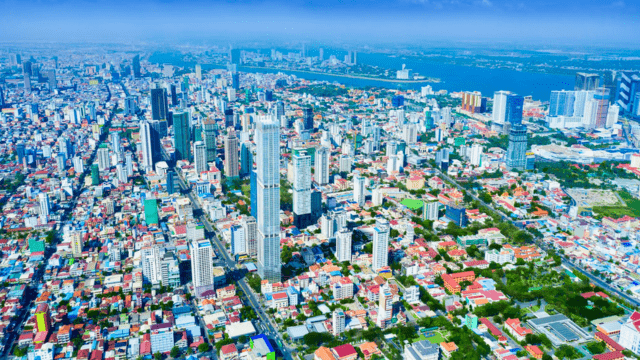
(4) Focus on high-demand rental areas like Phnom Penh
Limiting your investments to high-demand rental areas increases your odds of success.
For example, Phnom Penh:
- Has many resident foreigners
- Maintains strong rental demand
- Tend to have properties whose values are more resilient
However, even within Phnom Penh, areas differ:
- Tenant profiles
- Price levels
- Supply/demand balance
If you want to maximize your probability of success, you should also study the characteristics of each district.
(5) Choose properties from major, reputable developers
Selecting properties developed by large, credible developers helps mitigate risk.
With a major developer:
- The chance of projects being abandoned mid-construction is usually lower
- Pre-build risk can be reduced
- They often have accumulated know-how and quality standards
Because truly reliable players are still limited in Cambodia, it’s important to work with a broker who can connect you with solid developers, not just whoever is convenient.
For individual investors, especially beginners, “major + proven developer” is generally the safer route.
(6) Join local inspection / site-visit tours
Participating in a site-visit tour is another powerful way to avoid mistakes.
By visiting Cambodia directly, you can:
- See the actual condition of the city
- Check whether an area really has rental demand
- Experience the surroundings, infrastructure, and atmosphere first-hand
Talking directly with local residents also gives you:
- More real, on-the-ground insights
- A better sense of what’s hype vs. what’s real
Prepare a list of questions in advance to make the most of your visit.
(7) Secure guaranteed yields or profit terms in advance
If you want to further reduce risk, consider securing guaranteed yields or profit terms before buying.
For example:
- Rental guarantee schemes
- Contractual agreements on minimum return levels
Of course, guarantees also have conditions and limitations, so you need to:
- Understand the exact terms
- Compare different schemes
- Weigh them against the property’s fundamental value
But when used well, such structures can smooth out downside risk and improve your overall risk-return balance.

Conclusion
On the surface, Cambodian real estate looks extremely attractive:
- Rising property prices
- Potential for significant capital gains
- US dollar-based rental income and high yields
However, overseas markets operate under different norms and legal systems than Japan, and many investors have experienced painful failures.
If you want stable returns and to build assets through Cambodian property, it’s not enough to chase only the upside.
You need to:
- Study actual failure cases
- Apply concrete risk-mitigation strategies
- Choose properties and partners with careful due diligence
Use these 10 failure examples and 7 avoidance strategies as a checklist, and take a calm, step-by-step approach to Cambodian real estate investment.