What Is the Current Security Situation in Cambodia?
Author: Anna Araki / ANNA ADVISORS Inc.
Cambodia’s domestic economy is growing steadily, and the country is gaining attention as a destination for relocation and as a base for overseas business.
Both residential and commercial properties are increasing, and real estate transactions are active.
At the same time, high-profile news about border clashes with Thailand has led some people to feel uneasy about the current situation in Cambodia.
In this article, we will explain in detail the latest information on public security in Cambodia and the kinds of crimes that tend to occur there.
We will also introduce concrete safety measures for life on the ground, so please read through to the end.
Table of Contents
- Risk Level 1 or 3 According to Japan’s Ministry of Foreign Affairs (MOFA)
- Five Situations Requiring Particular Caution in Cambodia
- Entertainment Districts | Frequent Theft Targeting Foreigners
- Tourist Sites | Beware of Scams Targeting Tourists
- Night-Time | Walking Alone Is Not Recommended for Either Men or Women
- Eastern and Western Regions | Beware of Accidents Caused by Landmines and Unexploded Ordnance
- Infectious Diseases | Risk of Infections Transmitted by Animals
- Overall Crime Numbers in Cambodia Are on a Downward Trend
- Seven Types of Crime That Commonly Occur in Cambodia
- Snatch-Theft | One of the Most Frequent Crimes in Cambodia
- Rigged Gambling | Losses Can Be Huge Once You Get Involved
- Theft | Pickpocketing Is Common at Tourist Spots
- Robbery | Crimes Involving Firearms Also Occur
- Burglary | Even Hotel Staff May Commit Theft
- Special Fraud (“Dark Part-Time Jobs”) | Cases of Fraud Groups Being Busted in Cambodia
- Embezzlement | Think Carefully Before Entrusting Cash to Local Staff
- How Safety Changes by City and Time of Day – Organizing Risk by “Time” and “Place”
- Five Ways to Avoid Crimes That Commonly Occur in Cambodia
- For Pickpocketing and Snatch-Theft, the Critical Moment Is When You Stop Moving
- Prevent Overcharging at the “Payment” Stage
- Understand the Typical “Hooks” That Lead Into Rigged Gambling
- Avoid Drink-Spiking Robberies by Refusing the Set of “Kind Offer + Food/Drink”
- Stay Alert to Online Fraud and “Dark Part-Time Jobs” on Social Media
- Five Practical Measures to Make Daily Life Safer
- Three Lifestyle Designs to Ease the Fears of Women and Co-Residents
- Three Ways Security Affects Real Estate Investment
- Using Rankings and Regional Comparisons to Gauge “Acceptable Risk”
- Using Three Types of Reliable Information Sources
- Beware of Fraud Related to Real Estate Investment and Bank Account Opening
- ANNA ADVISORS Has Extensive Experience in Real Estate Investment and Bank Account Opening
- Conclusion
Risk Level 1 or 3 According to Japan’s MOFA
Japan’s Ministry of Foreign Affairs (MOFA) publishes safety information for countries around the world, and that information is updated as needed.
As of September 2025, Cambodia’s safety information is classified as follows.
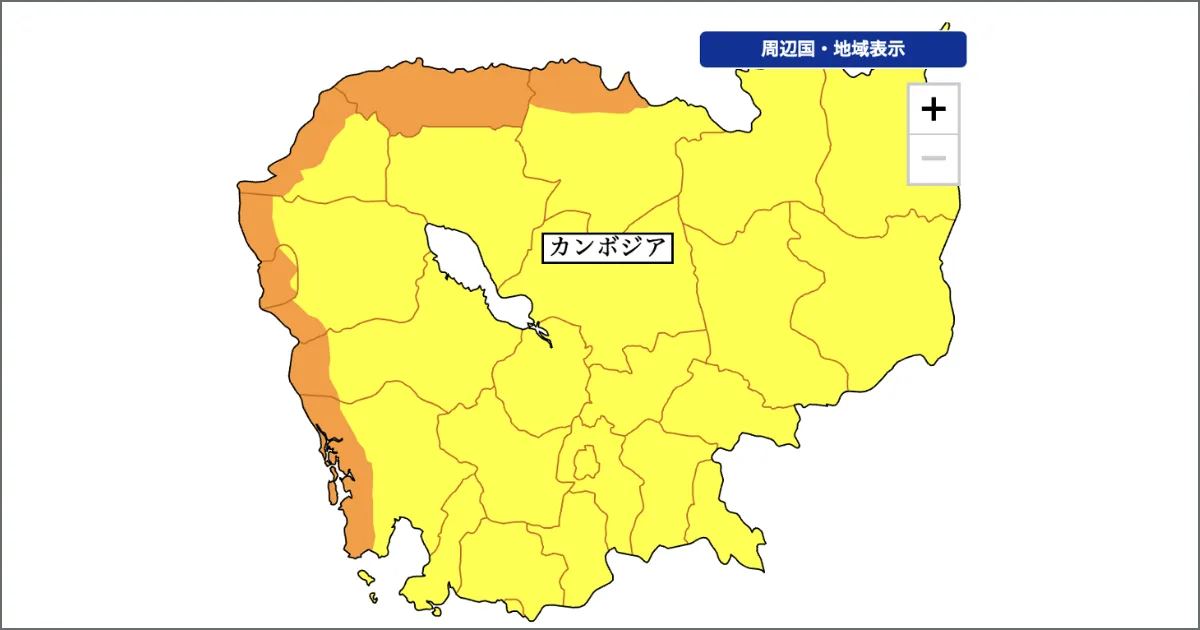
We will look at each classification in detail in the following sections.
Entire Country [Level 1] | Be Especially Careful About Theft
On MOFA’s website, the whole of Cambodia is designated as “Risk Level 1” or higher.
“Level 1” corresponds to “Exercise Caution,” and MOFA notes that theft, fraud, and robbery are likely to occur across the country.
Although Cambodia’s economy is growing briskly, the average income of the population remains well below the level of developed countries.
The income level of migrants and tourists from developed countries is often far higher than that of local residents, which makes them more likely targets.
In particular, Japanese people are widely perceived as affluent, and therefore more likely to be targeted. Extra caution is needed.
Border Areas [Level 3] | Deteriorating Security Due to the Border Dispute with Thailand
On MOFA’s website, certain border zones between Cambodia and Thailand are categorized as “Risk Level 3,” and a “Recommendation to Avoid All Travel” has been issued for those areas.
There are stretches along the Cambodia–Thailand border where the line of demarcation remains unclear, and these have been sources of tension for many years.
At the end of May 2025, a firefight broke out between military units around the Preah Vihear Temple area, a border zone shared by the two countries, over alleged incursions into each other’s territory.
Since then, tensions between the two militaries have risen sharply, and by July the situation escalated into large-scale clashes that caused casualties, including civilians.
Thanks to mediation by ASEAN as well as China and the United States, a ceasefire agreement has been reached. However, it cannot be said that tensions in areas along the Thai border have fully subsided.
To avoid getting caught up in unforeseen incidents, you should refrain from entering any area designated as high-risk.
We explain the Cambodia–Thailand border dispute in more detail in a separate article.
Five Situations Requiring Particular Caution in Cambodia
In Cambodia, risk tends to increase depending on the specific city, location, and time of day.
Here we outline five situations that call for particular caution.
Note that areas along the Thai border remain unstable, so you should avoid approaching them unless absolutely essential.
Entertainment Districts | Frequent Theft Targeting Foreigners
In large cities like Phnom Penh, the capital, entertainment districts bustle with tourists and foreign residents.
Because of the large crowds, pickpocketing, bag-snatching, and theft of unattended belongings are common, so care is needed.
Foreigners, including Japanese nationals, are often more affluent than local residents, and there are many cases in which foreigners are specifically targeted.
Some cases involve violent robbery where the victim was physically assaulted and injured.
Tourist Sites | Beware of Scams Targeting Tourists
In addition to Phnom Penh, you must also pay attention to public safety in other tourist destinations such as Siem Reap, known for Angkor Wat and other ruins, and Sihanoukville, a popular resort area.
In high-traffic cities like Siem Reap and Sihanoukville there are tour operators that overcharge foreign tourists with outrageous fees.
You should also be wary of people who approach tourists and foreigners in a friendly manner to beg for money or defraud them.
When using transportation such as taxis, there are cases where vehicles have no meter or where drivers demand excessive fares.
Night-Time | Walking Alone Is Not Recommended for Either Men or Women
In Cambodia, both men and women are advised to avoid walking alone at night as much as possible.
Entertainment districts in Phnom Penh offer a variety of nightlife options, but theft and overcharging are common risks.
Alcohol tends to lower inhibitions, and being drunk can increase your chances of becoming a victim of crime.
Because Cambodia is a tropical country, people tend to wear light clothing. For women, however, revealing outfits can unfortunately be a factor that invites sexual crime.
There are reported cases where people were assaulted by multiple offenders on poorly lit streets at night and robbed of their valuables. This is a concern not only for women but also for men, so everyone should be fully alert.
Eastern and Western Regions | Beware of Accidents Caused by Landmines and Unexploded Ordnance
In Cambodia, landmines laid during the civil war and the Vietnam War, as well as unexploded ordnance from US bombing, remain buried in large numbers. Many casualties have occurred, mainly in the east and west of the country.
The government and NGOs are working to clear these hazards, but the work is not yet complete.
Danger zones are marked with warning signs indicating that entry is prohibited. However, mines and unexploded ordnance may be present beyond the signposts as well.
In addition, you should not approach isolated roads, farmland, forests, or vacant lots where people or vehicles do not usually pass.
Major trunk roads in the eastern part of the country were key targets of bombing during the Vietnam War. Even in areas relatively close to these roads, caution is essential.
Infectious Diseases | Risk of Infections Transmitted by Animals
In Cambodia, mosquitoes and stray dogs are considered particularly high-risk animals.
In tropical and subtropical climates, mosquitoes can transmit infectious diseases such as tropical malaria.
If you contract tropical malaria and fail to receive treatment within 24 hours, it can cause severe, life-threatening symptoms.
Large numbers of stray dogs live in Cambodia, and there are cases where people have contracted rabies through bites or scratches.
Cats and bats that carry the virus can also transmit rabies. After an incubation period of several months, rabies leads to neurological symptoms and coma, and it is an extremely dangerous disease with a very high fatality rate.
Getting vaccinated before traveling to Cambodia can significantly reduce your risk of contracting these infectious diseases.


Overall Crime Numbers in Cambodia Are on a Downward Trend
According to Cambodia’s Ministry of Interior, there were 3,121 reported crimes in 2024, an 11.1% decrease from the previous year.
However, there may be cases that are not reflected in the statistics, so it is still essential to remain cautious while in the country.
The table below (not reproduced here) is based on statistics published by the Embassy of Japan in Cambodia and shows recent crime figures in Cambodia.
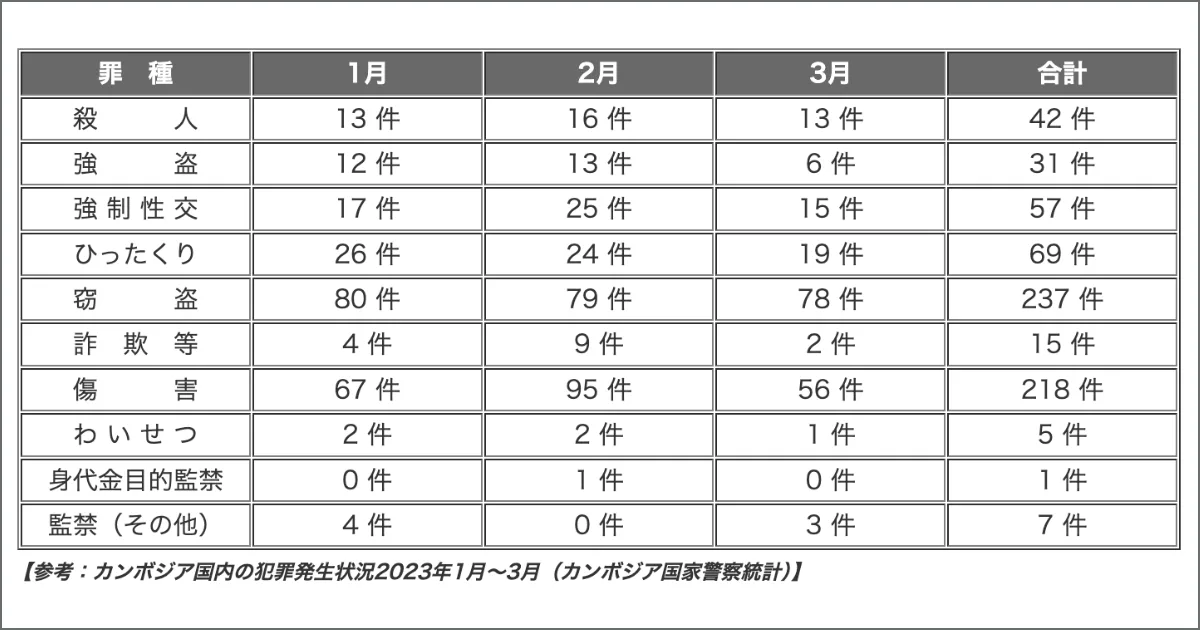
Source: Embassy of Japan in Cambodia – “Safety Measures Information for Overseas Travelers”
Among these incidents, Japanese nationals were victims in 5 snatch-theft cases, 2 theft cases, and 1 drink-spiking robbery.
Seven Types of Crime That Commonly Occur in Cambodia
Although many types of crime are reported in Cambodia, some occur more frequently than others.
Here we explain seven types of crime that are particularly common.
Snatch-Theft | One of the Most Frequent Crimes in Cambodia
Snatch-theft is one of the most frequent crimes in Cambodia. Perpetrators forcibly grab belongings such as bags and smartphones.
Motorbikes are often used in these crimes because they can travel at high speed and maneuver easily.
The typical targets are pedestrians or tuk-tuk drivers, who are less mobile than the perpetrators on bikes.
Some cases involve offenders cutting bag straps with knives and stealing them, or using such force to grab belongings that the victim is injured.
Rigged Gambling | Losses Can Be Huge Once You Get Involved
Rigged gambling often targets tourists or foreigners traveling alone.
Typically, a stranger approaches you in the street or at a tourist site, saying they want to “hear about Japan,” or using similar friendly conversation to draw you in, and then lures you to a private home or other location where the scam will take place.
Several accomplices will be waiting there. They propose “playing a game” and set up gambling with large stakes.
The group’s own players intentionally lose game after game at first, gradually encouraging the target to increase the stakes.
Throughout the game, multiple people behave in an intimidating way toward the target, creating an atmosphere in which it is psychologically difficult to refuse, even if you realize it is a scam.
If the victim tries to forcibly leave, thuggish individuals may appear, confiscate their phone and valuables, and block their escape.
Once the amount at stake exceeds the cash the victim has on hand, they are ordered to go to an ATM to withdraw more money, and the game is temporarily paused.
If they cannot withdraw the requested amount, they are forced to buy jewelry or precious metals, convert them into cash, and hand it over as part of the gambling “debt.”
After receiving the instructed amount, the scammers tell the victim they will “come back to pick you up,” leave them waiting in a café or similar location, and then never return.
Because large amounts of cash are involved in the gambling, losses often reach hundreds of thousands or even millions of yen.
Theft | Pickpocketing Is Common at Tourist Spots
Theft, including pickpocketing and stealing unattended belongings, frequently occurs at tourist sites and restaurants. Reported examples include:
- While visiting ruins, a passerby removed a wallet from the victim’s pocket
- While the victim left their table at a restaurant, their smartphone was taken from the tabletop
- While shopping in a mall, someone reached into an open backpack and stole items
- While walking, a group of children surrounded the victim, and when they realized it, their wallet had been taken from a shoulder bag
Adults are not the only perpetrators; children begging on the street may also steal from tourists, so you must stay alert.
Robbery | Crimes Involving Firearms Also Occur
Robbery involves using violence against the victim to forcibly seize their belongings. In Cambodia, the following kinds of cases have been reported:
- While walking in the city, a victim tried to chase someone who had stolen their phone, only to be surrounded by several men who cut their arms and legs with knives and stole their cash
- While walking along the riverside in Phnom Penh at night, a victim was assaulted by a group of men and robbed of cash, a DSLR camera, passport, and other belongings
- While riding a motorbike after leaving a casino late at night, a victim was followed by another bike; the rider threatened them with a pistol and stole their cash
In some cases, people have tried to chase snatch-thieves, only to be attacked in retaliation with weapons or by groups, suffering injuries as a result.
There have also been cases where criminals obtained firearms that had been diverted from police stocks for personal gain, which is one reason why robberies involving guns still occur.
In addition, there are drink-spiking robberies where offenders befriend targets, invite them out for a meal, secretly spike their food or drink with sleeping pills, and then commit theft while the victims are unconscious.
These incidents not only involve theft of cash and valuables, but in the case of women, there have also been reports of sexual assault and rape.
Burglary | Even Hotel Staff May Commit Theft
In Cambodia, burglars often target lower floors of apartment buildings and similar properties.
Low-rise units in buildings where outsiders can easily enter and exit are especially vulnerable.
There are also reports of theft targeting guests at hotels and guesthouses.
If you keep cash, credit cards, and other valuables at your accommodation, you must consider the risk that staff may be the perpetrators.
The average annual income of Cambodians is often cited as around USD 1,200 (about JPY 180,000 at JPY 150 per USD), which is far lower than the average income in Japan.
To local residents, the cash and credit cards carried by Japanese and other foreigners represent a very large sum; some may be unable to resist temptation and commit crime.
Special Fraud (“Dark Part-Time Jobs”) | Fraud Groups Based in Cambodia Have Been Busted
Starting around 2024, special fraud schemes (often advertised as “dark part-time jobs”) became a serious social problem, with a spate of incidents.
Some groups base their operations overseas to avoid investigation. In October of the same year, there was a widely reported case in which a fraud ring based in Cambodia was busted.
These groups often recruit participants through social media, offering seemingly too-good-to-be-true pay.
Typically, the group is split into “commanders” and “operatives.” Once the leaders have obtained personal data from the operatives, they can threaten them into committing criminal acts.
In fraud schemes based in Cambodia, operatives were flown into the country, and calls were placed from Cambodian phone lines to Japanese victims by perpetrators impersonating police officers or bank staff.
Embezzlement | Think Carefully Before Entrusting Cash to Local Staff
As with hotel staff, you must be alert to embezzlement by Cambodian employees.
The economic gap between Cambodia and Japan is huge. Even sums that may not feel large to a Japanese person can be perceived as very valuable by Cambodians.
The author herself has personally experienced embezzlement by a Cambodian employee.
During the first few years after starting her company, she lived in Cambodia while running her business. At the time, it was standard practice to collect rent by visiting each tenant in person.
Because she was pregnant and could not move around easily, she entrusted rent collection to a Cambodian employee.
With a large amount of cash passing through his hands, temptation apparently got the better of him, and he embezzled some of the collected rent.
The loss was about 500,000 yen: not enough to threaten the company’s continued existence, but the psychological shock of being betrayed by someone she trusted was significant.
How Safety Changes by City and Time of Day – Organizing Risk by “Time” and “Place”
In Cambodia, crimes tend to be more frequent in cities and time periods where many foreigners are present.
Here we organize key points to watch in certain cities and time frames.
Key Points for Phnom Penh
BKK1, Tonle Bassac, Riverside Areas – Cautions and “Safe Routes”
Districts like BKK1 (Boeung Keng Kang 1) and Tonle Bassac in Phnom Penh are popular residential areas for expatriates, but in riverside areas and back alleys at night, the risk of pickpocketing and robbery increases.
To secure safe routes, we recommend setting rules such as:
- Do not stray from main roads
- Use a ride-hailing app to get home
- Get dropped off right at your building entrance
There have been robberies along riverside promenades. In particular at night, you should avoid walking alone on side streets or away from main roads.
Key Points for Siem Reap
Ruins and Pub Street – Cautions and Rules for Getting Around
Siem Reap is one of Cambodia’s leading tourist cities, home to Angkor Wat and many other ruins.
While Siem Reap is relatively safe during the day, pickpocketing and scams are common around Pub Street at night, especially targeting intoxicated visitors.
When visiting for investment property inspections or for sightseeing, it is effective to set a personal rule such as “be back by 10 p.m.” and to avoid carrying more cash or cards than necessary.
Key Points for Port Cities
Spots to Avoid in Poipet, Bavet, and Sihanoukville
In border towns like Poipet and Bavet, troubles related to gambling and smuggling are common, so it is generally best to avoid visiting unless absolutely necessary.
Sihanoukville saw a surge of Chinese investment, but many Chinese investors have since pulled out. Today there are concerns about illegal casinos and deteriorating security in depopulated areas.
If you are doing business in port cities, it is important to minimize on-site visits and secure trustworthy local partners.
Five Ways to Avoid Crimes That Commonly Occur in Cambodia
Crimes such as pickpocketing, snatch-theft, scams, and fraud targeting foreigners are common in Cambodia.
Here we introduce five practical methods to reduce your risk.
1. For Pickpocketing and Snatch-Theft, the Critical Moment Is When You Stop Moving
In Cambodia, snatch-thefts by motorbike are more likely to occur when you are standing still than when you are walking.
Never carry your bag on the street side; always keep it on the side facing the buildings.
Using your smartphone while walking makes you less aware of your surroundings and increases the likelihood of being targeted.
Try to use your phone only while stationary, and consider carrying a paper map rather than relying entirely on navigation apps.
Because skilled pickpockets can steal from you without your noticing, you should carry valuables on the front of your body whenever possible.
2. Prevent Overcharging at the “Payment” Stage
When shopping in town, there is a risk that change will be shorted.
If you must pay in cash, use smaller bills when possible and always check your change on the spot.
If available, using mobile payment is recommended to avoid disputes over amounts.
For goods and services, confirm prices before purchasing. Doing so will help you avoid trouble when it is time to pay.
3. Understand the Typical “Hooks” That Lead Into Rigged Gambling
Scams such as rigged gambling usually begin with the perpetrator approaching the target in a friendly manner.
The scam is carried out after the target has been lured to a specific location, but there are many potential lead-in lines: for example, asking for directions and then saying “I’d like to thank you somehow.”
Cambodians are generally friendly even to strangers. Still, you should be wary of people who seem excessively familiar from the outset.
3. Understand the Typical “Hooks” That Lead Into Rigged Gambling
Scams such as rigged gambling usually begin with the perpetrator approaching the target in a friendly manner.
The scam is carried out after the target has been lured to a specific location, but there are many potential lead-in lines: for example, asking for directions and then saying “I’d like to thank you somehow.”
Cambodians are generally friendly even to strangers. Still, you should be wary of people who seem excessively familiar from the outset.
5. Stay Alert to Online Fraud and “Dark Part-Time Jobs” on Social Media
Recently, email and SMS phishing scams have been on the rise.
Do not click links in messages immediately. Instead, make a habit of checking via official websites or phone numbers.
There have been cases where special fraud groups with bases in Cambodia recruited “operatives” through social media.
Phrases like “make easy money” or “earn XX hundred thousand yen per month doing translation work” are used to attract users, who are then directed to registration forms and turned into operatives for scams.
These scams are not limited to online recruitment; they can also be introduced through acquaintances, so caution is essential.
Five Practical Measures to Make Daily Life Safer
Incorporating a few safety practices into your daily life in Cambodia can significantly raise your overall level of security.
Here we introduce five measures that are especially effective.
1. At Night, Make Sure You Get Home “All the Way to the Front Door”
Crime often occurs in the last few dozen meters before you reach your home.
When returning at night, if possible, use a ride-hailing app and set your destination so that the car pulls right up to your building entrance. After getting out, go straight inside.
If you are walking home, stay alert until you have stepped through the door.
2. Use Both Ride-Hailing Apps and a Dedicated Driver
For short-term visitors, ride-hailing apps such as Grab are convenient.
For long-term residents, however, it can be worth hiring a dedicated driver if your budget allows.
By using a dedicated driver at night and ride-hailing apps during the day, you can balance safety and cost-efficiency.
If hiring a driver is financially difficult, taxis can be a viable alternative.
3. Be Careful How You Carry Your Wallet, Phone, and Passport
If you keep your wallet, smartphone, and passport all in the same place, the impact of theft can be severe.
Reduce your risk by splitting valuables into several locations and even preparing a decoy wallet.
Keep valuables in places close to your body—for example, an inside pocket of your trousers—so that you notice quickly if they are stolen.
4. Check Residential Security in Advance
When searching for housing in Cambodia, check the level of security: 24-hour guards, CCTV coverage, entrance control systems, and so on.
Even if rent is higher, choosing a property with strong security often works out cheaper in the long run.
Our company handles many properties in and around Phnom Penh and can introduce options with a strong emphasis on security.
5. Know Emergency Contacts and How Long It Takes to Reach Medical Care
In emergencies, “ingrained routines” are more effective than information you only know in your head.
If your family will be living in Cambodia, physically travel the route to the nearest hospital in advance and measure how long it takes.
If you become a victim of crime in Cambodia, contact the local police (phone number 117) immediately.
After you file a report, the police will issue a crime report certificate (police report), which you will need for passport reissuance or insurance claims.
Be aware that local police officers may not speak English.
If you need an interpreter, you can arrange one via the Embassy of Japan in Cambodia, which provides services in Japanese and can help you secure a lawyer in cases of fraud or other serious trouble.
| Embassy of Japan in Cambodia | 023-217-161~4 | https://www.kh.emb-japan.go.jp/ |
| Consular Office of Japan in Siem Reap | 063-963-801~3 | https://www.kh.emb-japan.go.jp/itpr_ja/00_000091.html |
Note that both the embassy and the consular office are closed on weekends.
Three Lifestyle Designs to Ease the Fears of Women and Co-Residents
When a couple or family stays in Cambodia, designing daily life with women and children in mind makes it easier to keep everyone safe.
Here we outline three such approaches.
1. Be Mindful of Routes and Times for School, Shopping, and Lessons
For families living in Cambodia, the safety of the routes used in daily life is especially important.
As a rule, choose daytime routes along main roads for school, supermarkets, and lessons, and combine pickups and ride-hailing services instead of walking whenever possible.
For children’s school commutes, aim for routes that take 15–20 minutes or less along main roads to minimize risk.
2. Set “Personal Rules” for Nightlife and Public Spaces
A spouse living with you may occasionally go out at night to night markets, bars, and other venues.
To keep night outings safer, it is helpful to set rules such as:
- Always go out with at least one companion
- Avoid flashy clothing
- Set a curfew for coming home
By sharing such family rules in advance, you can reduce the likelihood of unexpected trouble.
3. Make a Habit of Checking In and Sharing Locations at Home and When Out
Lack of information sharing within the family can itself become a safety risk.
For example, you might establish rules like the following:
- Always tell someone when you go out and when you come home
- Share your location using an app
- Have a code word to confirm safety in an emergency
By consistently following such “small habits,” families can significantly enhance their overall safety.


Three Ways Security Affects Real Estate Investment
Security conditions in Cambodia have a direct impact on real estate investment.
Here we explain three key factors.
Neighborhood Safety Is Directly Linked to Rent Levels and Occupancy
Location is always a crucial factor in real estate investment, and in Cambodia the security of the surrounding area is particularly important.
Even in central Phnom Penh, areas with good security along main roads and with robust on-site guards tend to be popular among expatriates and wealthy locals. Rents in such areas are easier to maintain.
On the other hand, in areas where security is a concern, vacancy risks increase and rent hikes are difficult.
Because security strongly affects your profit and loss, you should pay even more attention to it than you might when investing in properties in Japan.
Impact on Turnover, Repair Costs, and Restoration Costs
In areas with poor security, residents often move out quickly due to crime or a sense of insecurity.
As a result, landlords face frequent repair and restoration costs at each turnover.
Selecting safe areas where long-term tenancies are likely not only stabilizes cash flow but can also reduce maintenance costs.
Balancing Insurance Premiums, Maintenance Costs, and Security Expenses
In locations with poor security, fire and liability insurance conditions may be stricter and premiums higher.
You may also need to budget for on-site security staff, additional CCTV cameras, and other security measures.
When making investment decisions, it is important to model scenarios such as:
“Rental income − (insurance premiums + security expenses).”
Using Rankings and Regional Comparisons to Gauge “Acceptable Risk”
To understand Cambodia’s security situation, you can use global rankings and comparisons with neighboring countries as reference points.
However, misreading this information can lead to incorrect conclusions, so caution is needed.
Here are three tips for making accurate judgements.
How to Read Global/Asian Security Rankings – and Their Limitations
Websites that publish “global security rankings” often rank countries by indicators such as crime rates and the number of violent incidents.
While this can be helpful for tourists, it may not be sufficient for investors.
Investment decisions are also influenced by factors such as contract transparency, levels of corruption, healthcare systems, and infrastructure reliability.
Instead of relying solely on overall ranking, identify which indicators matter to your own situation and read the rankings with those in mind.
Relative Comparison with Thailand, Vietnam, and the Philippines
If we compare basic public security among Cambodia and its neighbors, a rough characterization is:
- Thailand: relatively stable in major tourist areas
- Vietnam: relatively little variation in security between major cities
- Philippines: large gaps in security between regions
Compared with these countries, Cambodia is often assessed as having a relatively high incidence of minor crimes, but a comparatively low incidence of very serious risks.
By assessing public security alongside factors such as real estate prices, prevalence of English, and availability of support from local agents or intermediaries, you can make more realistic investment decisions.
Turning Judgement Criteria into Concrete Numbers
Ultimately, your tolerance for security risk will strongly influence whether or not you conclude contracts.
For example, you might set criteria such as:
- Whether to travel: avoid all travel to areas at Level 2 or higher
- Hours of activity: no going out after 10 p.m.
- Bringing family: allowed in central Phnom Penh but not near borders
By setting specific numbers and rules, you can make better use of security information in your decision-making.
Using Three Types of Reliable Information Sources
Public-sector websites and social media can be very useful for understanding Cambodia’s security situation.
Here we divide key information sources into three types.
Government Sources: Getting Reliable Information from MOFA and Other Advisories
Japan’s MOFA “Overseas Safety” website is extremely useful for understanding local conditions.
Travel advisories from other governments (such as the US, UK, and Australia) are updated quickly and help you capture the latest information.
Before traveling or making investment decisions, it is wise to check multiple government advisories.
Local Sources: Using Expat Networks and Industry Communities
In cities like Phnom Penh and Siem Reap, there are established communities of Japanese residents and industry professionals.
Many such communities share up-to-date safety information via Facebook groups and chat apps.
For example, you may see posts like “A pickpocket incident occurred in this area last night.”
By tapping into these communities, you can access real-time safety information that is hard to grasp from official sources alone.
User Sources: How to Use Q&A Sites and Reviews
Sites like Yahoo! Chiebukuro and travel forums are full of real user experiences.
However, because posts can be subjective or exaggerated, it is important to look at multiple accounts and evaluate them as a whole.
For instance, if there are numerous posts saying “My wallet was stolen on Pub Street at night,” you can treat that as a relatively credible warning.
Beware of Fraud Related to Real Estate Investment and Bank Account Opening
In Cambodia, the following types of trouble related to real estate investment and bank account opening have been reported:
- Uncompleted pre-built properties: New-build properties paid for in stages based on construction progress that were never completed due to developer withdrawal, leading to total loss of investment
- Losses due to poor management: Poorly run management companies that failed to remit rental income properly, making normal operations impossible
- Lack of support after bank account opening: Cases where funds in a bank account were frozen after opening, and the intermediary could no longer be contacted
Real estate investment and bank account opening in Cambodia can be arranged via individuals, but these intermediaries often provide little or no after-sales support, leaving clients unable to resolve problems.
It is also common for property payments to follow a “pre-build” model, with installments tied to construction milestones. If the project remains uncompleted, the entire amount invested may be lost.
In addition, poorly run management companies may neglect financial management and property maintenance.
To avoid such problems, it is crucial to avoid ad-hoc contracts mediated by individuals as far as possible, and instead choose reliable, professional firms.
ANNA ADVISORS Has Extensive Experience in Real Estate Investment and Bank Account Opening
Our firm provides asset-building support services that utilize foreign investment, including Cambodian real estate investment and bank account opening.
Below we introduce our main services in more detail.
Real Estate | Supporting Multiple Uses: Investment, Migration, and Local Business
We handle overseas properties in multiple countries and can meet a wide range of needs in Cambodia, including investment, migration, and corporate expansion.
Our representatives and staff personally inspect each property, and we only broker properties that meet our internal screening standards.
We also maintain an office in Phnom Penh, allowing us to show prospective clients properties on the ground.
We place strong emphasis on property management: by using our system, clients can monitor the performance of their investment properties in real time.
We explain Cambodian real estate investment in more detail in another dedicated article.
Bank Accounts | Robust After-Support
Opening a bank account in Cambodia offers several advantages, including:
- Average interest on fixed deposits of around 4–5%
- Ability to hold deposits in USD
- Many banks allow accounts to be opened entirely via online procedures and postal mail
- Non-residents are often allowed to open accounts
- Many banks offer services in Japanese
- Minimum deposit amounts from around USD 100 (approx. JPY 15,000 at JPY 150 per USD), making it accessible
Opening a bank account is much easier than investing in real estate, and many of our clients—including homemakers and company employees—start here.
We also focus on after-sales support: we provide usage manuals for each bank’s app and guidance on what to do in the event of account freezes, among other services.
Rather than one-off transactions, we place importance on building long-term relationships and supporting clients over many years.トのご提供を重視しております。
Conclusion
Throughout Cambodia, minor crimes such as pickpocketing and snatch-theft occur relatively frequently.
Because Japanese nationals, with their higher income levels, are sometimes targeted, it is important to remain cautious while in the country.
From May to July 2025, military clashes broke out with Thailand over border disputes.
Although a ceasefire agreement has now been reached, the situation in areas near the Thai border remains unstable.
By understanding the types of crimes that commonly occur in Cambodia and taking appropriate precautions, you can stay in the country much more safely.
With proper safety measures in place, Cambodia is by no means an inherently dangerous country.
In addition to investment, we broker properties suited to migration and local business operations.
We also provide comprehensive support for opening Cambodian bank accounts, including after-care.
We regularly host seminars in Japan and local tours in Cambodia for those interested in Cambodian real estate investment and bank account opening.
We warmly invite you to join us.