A Complete Guide to Relocating to Cambodia: Visas, Permanent Residence, Living Costs, and Housing Explained
Author: Anna Araki / Anna Advisors Co., Ltd.

Cambodia is located close to Japan and is an attractive destination for relocation thanks to its unique culture and climate. With steady economic growth, it has also gained popularity as a destination for corporate expansion and a business hub.
In this article, we provide a detailed explanation of Cambodia as a relocation destination. We will cover local conditions, visa types, permanent residency, and more—so please stay with us until the end.
https://youtube.com/watch?v=dgA36DorDhE%3Ffeature%3Doembed%26enablejsapi%3D1%26origin%3Dhttps%3A
Table of Contents
- Basic Data on Cambodia
- 7 Key Advantages of Relocating to Cambodia
- 7 Major Disadvantages and Precautions When Relocating
- 5 Key Local Conditions in Cambodia
- Visa Types for Relocating to Cambodia
- How to Move to Cambodia: Step-by-Step Guide
- Who Is Best Suited for Living in Cambodia? (3 Key Types)
- 3 Recommended Cities for Living in Cambodia
- Anna Advisors Provides Full Support for Relocating to Cambodia
- Summary
Basic Data on Cambodia
First, let us review the basic data on Cambodia.
| Area | 181,035 square kilometers |
| Population | 16.9 million (UNFPA, 2023) |
| Capital | Phnom Penh |
| Ethnicity | Approximately 90% of the population is Cambodian (Khmer) |
| Language | Khmer |
| Religion | Buddhism (some minorities practice Islam) |
| Main Industries | Agriculture (24.3% of GDP) Industry (39.2% of GDP) Services (36.4% of GDP) (ADB, 2021) |
| Nominal GDP | Approx. USD 30.9 billion (IMF estimate, 2023) |
| GDP per Capita | USD 1,920 (IMF estimate, 2023) |
| Major Trading Partners | Exports: United States (39.9%), EU (18.0%), Vietnam (9.6%), China (5.5%), Japan (5.2%) Imports: China (34.9%), Vietnam (13.2%), Thailand (12.8%), Singapore (10.8%), Japan (2.6%) |
| Exports: United States (39.9%), EU (18.0%), Vietnam (9.6%), China (5.5%), Japan (5.2%) Imports: China (34.9%), Vietnam (13.2%), Thailand (12.8%), Singapore (10.8%), Japan (2.6%) | 3,215 (as of October 2023) |
| Number of Cambodians in Japan | 21,592 (as of June 2023) |
Source: Ministry of Foreign Affairs of Japan
According to data from the Ministry of Foreign Affairs, trade and investment relations with Japan are as follows:
- Exports to Japan: Approx. JPY 269.2 billion (mainly clothing, footwear, leather goods)
- Imports from Japan: Approx. JPY 70.4 billion (mainly machinery such as construction equipment, vehicles, food products such as meat, electrical equipment, textile yarn and machinery)
- Direct Investment from Japan: Approx. USD 3 billion
- Investment Sectors and Japanese Companies: Garment manufacturing, footwear, automotive parts, medical, construction materials, major retail chains, hotels, among others
Relations between Cambodia and Japan are very favorable, with active exchanges in political, economic, and cultural fields. In the economic sphere, Japan is one of Cambodia’s major trading partners for both exports and imports, and agreements on investment liberalization have also been concluded. Politically, in January 2023, both countries upgraded their relationship to a Comprehensive Strategic Partnership, creating even closer ties.
Japan actively supports Cambodia through the government and JICA (Japan International Cooperation Agency), contributing significantly to Cambodia’s development. This proactive support is widely recognized in Cambodia, and it is often said that Cambodians feel a strong sense of goodwill toward Japan.
7 Key Advantages of Relocating to Cambodia
Here, we explain seven major advantages of relocating to Cambodia. Cambodia offers many benefits and can be considered a very attractive relocation destination.
Lower Living Costs Compared to Japan
Living expenses in Cambodia after relocation tend to be lower than in Japan. When comparing prices in Phnom Penh with those in Tokyo, the price ratios are as follows:
| Item | Average Price (JPY) | Average Price in Tokyo | Ratio vs Tokyo |
|---|---|---|---|
| Meal at an inexpensive restaurant | ¥774 | ¥1,000 | 77% |
| Meal at an average restaurant (course for 2–3 people) | ¥4,643 | ¥7,000 | 66% |
| McDonald’s value set | ¥1,083 | ¥800 | 135% |
| Domestic draft beer (500ml) | ¥155 | ¥500 | 31% |
| Cappuccino (regular) | ¥452 | ¥490 | 92% |
| Cola (330ml bottle) | ¥150 | ¥173 | 87% |
| Water (330ml bottle) | ¥141 | ¥115 | 122% |
| Bottle of wine | ¥1,857 | ¥1,100 | 169% |
| Cigarettes (Marlboro, 20-pack) | ¥271 | ¥600 | 45% |
| Milk (1 liter) | ¥334 | ¥233 | 143% |
| Bread (500g) | ¥306 | ¥267 | 115% |
| White rice (1kg) | ¥153 | ¥494 | 31% |
| Chicken tenderloin (1kg) | ¥678 | ¥1,079 | 63% |
| Beef thigh meat (1kg) | ¥1,594 | ¥3,072 | 52% |
| Apples (1kg) | ¥692 | ¥813 | 85% |
| Bananas (1kg) | ¥300 | ¥383 | 78% |
| Tomatoes (1kg) | ¥231 | ¥731 | 32% |
| Potatoes (1kg) | ¥243 | ¥424 | 57% |
| Lettuce (1 head) | ¥280 | ¥209 | 134% |
| One-way ticket (local transportation) | ¥155 | ¥200 | 77% |
| Taxi fare (1km, standard rate) | ¥155 | ¥420 | 37% |
| Gasoline (1 liter) | ¥183 | ¥173 | 106% |
| Utilities & garbage disposal for an 85㎡ apartment | ¥16,986 | ¥27,429 | 62% |
| Monthly mobile phone plan (including calls & 10GB data) | ¥916 | ¥3,822 | 24% |
| Internet (60 Mbps or higher, unlimited data) | ¥4,767 | ¥4,853 | 98% |
| Monthly fitness club fee for one adult | ¥7,643 | ¥9,043 | 85% |
| One pair of jeans (Levi’s 501 etc.) | ¥3,715 | ¥7,692 | 48% |
| One summer dress (ZARA etc.) | ¥3,515 | ¥5,355 | 66% |
| Men’s business shoes | ¥9,199 | ¥11,890 | 77% |
| Kindergarten (full day, 1 child) | ¥55,205 | ¥75,650 | 73% |
| International elementary school (annual, 1 student) | ¥2,107,040 | ¥2,267,353 | 93% |
| Apartment in city center (1 bedroom) | ¥77,063 | ¥149,682 | 51% |
| Apartment purchase price in city center (per 1㎡) | ¥353,827 | ¥1,236,979 | 29% |
| Housing loan interest rate (20-year fixed) | Annual rate 11.0% | Annual rate 1.69% | 651% |
Source: NUMBEO “Cost of Living (Cambodia) 2024”
From the table, it is clear that Phnom Penh is cheaper than Tokyo in almost all categories, especially rent and property prices, which show a significantly lower ratio. In addition, food, alcohol, cigarettes, transportation, clothing, and mobile phone fees are also much cheaper than in Japan, making it easier to reduce living expenses. Although rarely used by Japanese residents, mortgage interest rates in Cambodia are significantly higher than in Japan.
Lower Taxes Than Japan
Cambodia’s tax rates are lower than those of Japan as follows:
- Personal Income Tax: 0–20% (Japan: 5–45%)
- Corporate Tax: 20% (Japan: 23.2%)
In Japan, income tax is set at a high level at both the minimum and maximum, and especially high-income earners bear heavy tax burdens. Although corporate tax rates appear similar at face value, the difference in deductible amounts grows as business revenue increases. For this reason, wealthy individuals sometimes choose overseas relocation due to heavy tax burdens, and Cambodia is becoming one of the relocation options due to its lower taxes.
Regarding real estate investment, capital gains tax for individuals in Cambodia is currently exempt, but discussions are underway to introduce taxation, making future developments uncertain.
Widespread Use of U.S. Dollars and Reduced Currency Risk
In Cambodia, U.S. dollars are widely circulated throughout most regions of the country. Both business and personal transactions can be conducted in U.S. dollars, allowing expatriates to naturally hold assets in U.S. dollars through relocation.
By retaining assets in Japanese yen as well, one can hold two types of currency, which is highly effective as a hedge against exchange rate risks. Major banks such as SMBC Prestia allow account holders to maintain yen accounts even while living abroad, so opening an account before departure is recommended.
Strong Economic Conditions and Ease of Finding Employment
Cambodia’s GDP continues to grow steadily, indicating healthy economic conditions. This growth has attracted the attention of many companies, leading to an increasing number of businesses expanding into Cambodia.
With active business development by both domestic and foreign companies, many job opportunities are available, making local job hunting easier. The number of Japanese companies entering Cambodia is also increasing, raising the likelihood of Japanese nationals being hired locally.
Friendly and Pro-Japanese Population
Cambodians are known for being kind and friendly toward everyone. While Japanese people tend to be reserved when interacting with strangers in public, Cambodians often have a gentle nature and readily engage with passersby. This friendly temperament is a unique appeal not easily found in Japan and contributes greatly to a comfortable living environment.
Cambodians are generally pro-Japanese, and simply being Japanese often leads to favorable treatment. The kindness and warmth of Cambodians are also cited as major attractions by Japanese employees stationed at our Phnom Penh office.
Food That Suits Japanese Tastes
Cambodian cuisine is characterized by natural seasoning with limited oil and spices, which makes it easy to suit the Japanese palate. Because everyday meals are enjoyable, daily life can be lived comfortably. Perhaps due to these similar food preferences, there are many Japanese restaurants in Cambodia, and Japanese residents frequent them often.
During our local inspection tours, we offer participants meals at Cambodian restaurants and famous eateries, which receive very positive feedback.
Warm Climate Throughout the Year
Cambodia has a tropical monsoon climate and is warm and humid throughout the year. The average annual temperature remains around 30°C, with no true winter season. This climate is particularly comfortable for people who dislike cold weather.
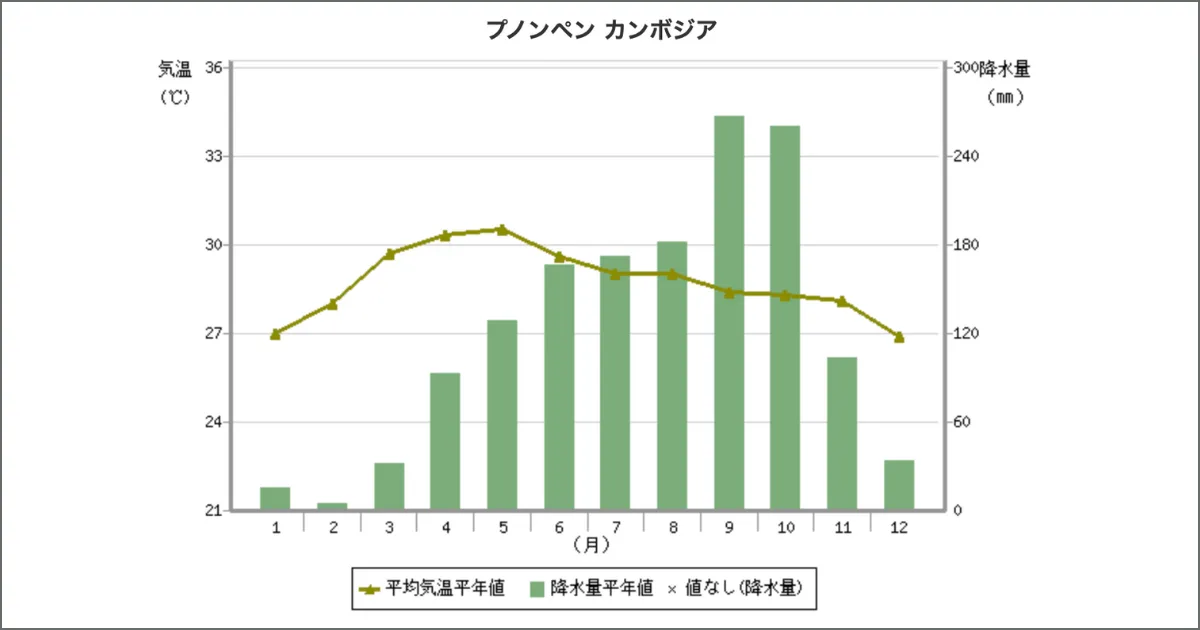
常夏の気候で冬がないため、寒さが苦手な方は特に快適に過ごしやすいでしょう。


7 Disadvantages and Precautions When Relocating to Cambodia
When relocating to Cambodia, there are not only advantages but also disadvantages and precautions to consider. Below are seven major points.
Rainy Season and Unstable Weather
Cambodia has two main seasons: the dry season and the rainy season. During the rainy season from May to October, the weather is hot, humid, and rainy, making conditions uncomfortable. Rainfall peaks particularly in September and October, sometimes causing roads to flood. Unlike Japan’s rainy season, Cambodia experiences short but intense tropical downpours mainly in the afternoon and evening.
Insects Are Prone to Reproduction and Tend to Be Large in Size
Because Cambodia has no cold season and remains warm throughout the year, it is an environment in which insects and other small creatures can easily live.
Since they can remain active throughout the entire year, insects tend to reproduce easily and also tend to grow large in size.
The insects and small creatures that commonly appear in Cambodian residences include the following:
Ants: They are particularly likely to appear in aging buildings, and in some cases, they may build nests inside the structure itself. Their population is extremely large, and depending on the species, their bites may cause severe swelling and pain.
Cockroaches: These are representative household pests that invade homes, and many species are larger than those found in Japan. The American cockroach, which is found in Okinawa and other areas, is said to originate from Southeast Asia.
Geckos: Because they feed on pests such as cockroaches, they can be beneficial, but for people who dislike their appearance, they may be unpleasant. They are more common than in Japan and tend to appear inside homes easily.
Mosquitoes: They increase in number during the rainy season and become very active. In Cambodia, they may serve as vectors for diseases such as dengue fever and malaria.
In Cambodia, people encounter insects more frequently than in Japan, and while some people gradually become accustomed to this, for those who dislike insects, it can become a source of stress.
Buildings with older construction or lower floors tend to be more prone to insects, so for those who are concerned, newer buildings on higher floors are recommended.
Many of the high-grade properties brokered by our company are built with high airtightness and structures that make it difficult for living creatures to enter.
Infrastructure and Medical Systems Are Not Fully Developed
Compared to Japan, Cambodia’s infrastructure is not fully developed, and in particular, vulnerability in electricity supply has been pointed out.
Because Cambodia cannot meet its necessary electricity demand solely through domestic power generation, it relies heavily on electricity imports from Thailand and Vietnam.
Because import costs are added, electricity bills tend to be high, and because the domestic transmission network is underdeveloped, power outages tend to occur frequently.
In addition, the medical system is insufficient, and serious injuries or illnesses may require medical treatment in Thailand, Singapore, or Japan.
If medical evacuation from within Cambodia becomes necessary, medical expenses can become extremely expensive, so it may be advisable to obtain medical insurance.
Petty Crimes Occur Frequently
In Cambodia, petty crimes such as bag snatching in which valuables are forcibly stolen while passing by, as well as pickpocketing and theft left unattended, tend to occur frequently.
Below is a statistical table classifying the types of crimes that occurred in Cambodia from January to March 2023.
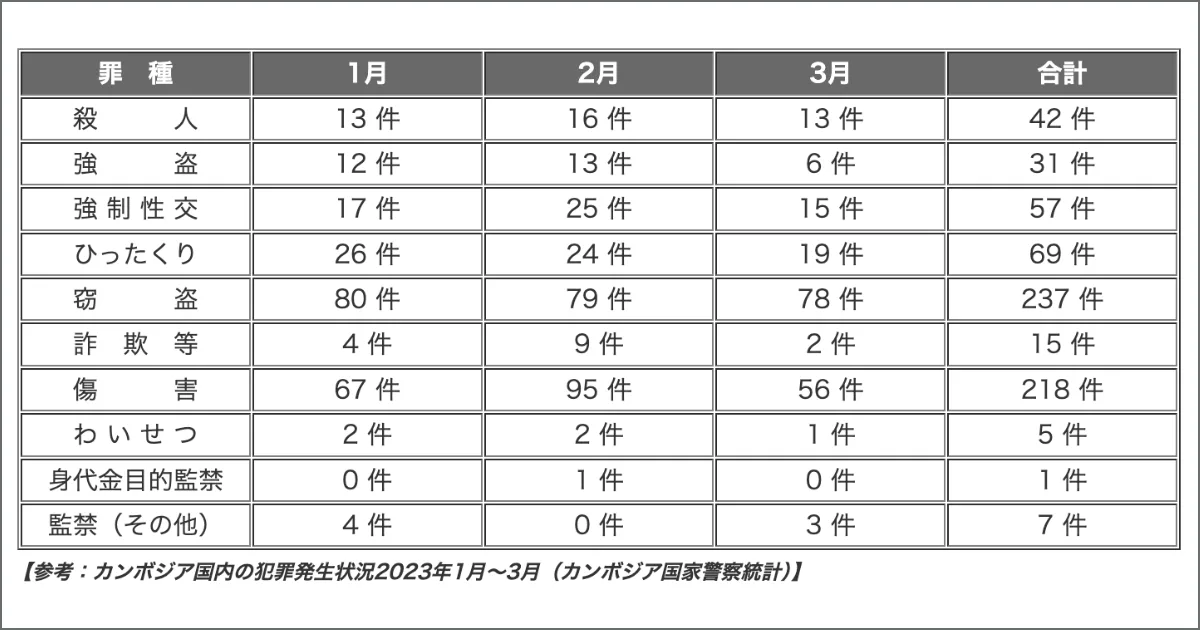
Source: Embassy of Japan in Cambodia, “Overseas Safety Information”
According to embassy statistics, among the above, crimes encountered by Japanese nationals included five cases of bag snatching, two cases of theft, and one case of drug-facilitated robbery.
Robberies in which perpetrators approach in a friendly manner, place sleeping medication into drinks to render the victim unconscious, and then steal valuables are crimes that often target tourists and foreigners.
You should be extremely cautious of individuals who show excessive friendliness or of members of the opposite sex who display seductive behavior.
Because Japanese people are widely recognized as having high income levels and being wealthy, it can be said that extra caution is necessary against bag snatching and theft.
When living in Cambodia, make it a habit to always pay close attention to your belongings and keep your valuables on your person at all times.
Traffic Manners Are Not Very Good
Overall, traffic manners in Cambodia are poor, and traffic accidents tend to occur easily.
Dangerous driving such as ignoring traffic signals and making self-centered lane changes is common, so caution is required.
Drunk driving and driving without a license are also not rare, and because traffic inspections are lax, illegal driving tends to be widespread.
In addition, Cambodia has aspects in which public authority does not function properly, and there are cases in which police officers fabricate traffic violations for the purpose of pocketing fines.
Such misconduct by police officers often targets foreigners; however, the Hun Manet administration views corruption of public authority as a problem and is strengthening enforcement against misconduct and enhancing penalties.
There Are Many Scams Related to Real Estate Contracts
In Cambodia, real estate contract fraud targeting foreigners who are unfamiliar with local conditions and have difficulty understanding local trends has been occurring.
High-value fraudulent transactions targeting foreign investors are particularly likely to occur, but there is also the possibility that migrants may be targeted, so caution is required.
There are also cases in which even veteran investors have been deceived, and organized criminal activity can be observed.
Compared to the general economic standard of Cambodians, Japanese people are extremely wealthy and are often targeted for fraud.
Even Japanese-affiliated companies may exploit the sense of security created by “being fellow Japanese” and carry out fraudulent acts, so trusting too easily is dangerous.
Real estate-related fraud in Cambodia is explained in detail in this article.
There Are Currently No Direct Flights to Japan
As of February 2025, there are no direct flights operating between Cambodia and Japan.
Previously, there were direct flights connecting Narita and Phnom Penh, but these flights have remained suspended since the COVID-19 pandemic.
Because there are no direct flights to Cambodia, travelers must transfer at airports in neighboring countries.
Depending on the flight, because it requires routing through another country, the average travel time between Narita and Phnom Penh is approximately 8 to 10 hours.
Flights with long transfer waiting times tend to have lower airfare, but travel time becomes even longer, with some flights exceeding 12 hours.
Five Noteworthy Local Conditions in Cambodia
When relocating to Cambodia, it is also important to understand local conditions.
Here, we explain five aspects of local conditions in Cambodia.
Politics | A Dictatorship Under the Hun Regime, but Political Stability Is Maintained
In Cambodia, Hun Manet, the son of Hun Sen, assumed office as prime minister in 2023, marking the first hereditary succession in 38 years and establishing a de facto dictatorial system.
Although the word “dictatorship” tends to evoke a negative image, because the political situation is stable and there are no major internal conflicts, public safety conditions are relatively good.
Prime Minister Hun Manet pursues an active foreign policy, and as part of his policy, he is characterized by promoting the attraction of foreign companies and encouraging investment activities by foreigners.
Religion | The Majority of the Population Is Buddhist
In Cambodia, the majority of the population is Buddhist, and Buddhism is the state religion.
There are no particularly strict commandments, but it is taboo for women to touch monks, and also taboo to touch another person’s head.
In Cambodia, it is believed that a spirit resides above the head, and touching the head is interpreted as an act of driving that spirit away.
In Japan, people sometimes pat another person’s head as a gesture of affection or familiarity, but in Cambodia this is taboo, so caution is necessary.
In addition, visiting ruins while wearing revealing clothing such as sandals or skirts is also prohibited, so extra care should be taken.
Water | Tap Water Is Drinkable in Phnom Penh
This may come as a surprise, but tap water in Phnom Penh has highly advanced filtration technology and is clean enough to be consumed as-is.
With the cooperation of JICA, the quality of Phnom Penh’s tap water is maintained at a high level, and this is also considered one of the reasons why Cambodians feel affinity toward Japan.
However, while tap water in Japan is soft water, Cambodia’s tap water is hard water.
If you feel it does not suit your constitution, drinking mineral water is safer.
In general Cambodian households, water servers are widely used, most commonly the type that requires installing bottles of mineral water.
Outside Phnom Penh, the safety of tap water is uncertain, so it is better to avoid drinking it.
Toilets | Western-Style Flush Toilets Are Widespread in Most Areas
With the growth of the domestic economy, western-style flush toilets have become widespread in many areas of Cambodia.
In urban areas such as Phnom Penh, toilets with warm-water washing functions have also been introduced, and many toilets feel clean even by Japanese standards.
However, in toilets with narrow pipes and low water flow, used toilet paper is disposed of in a provided trash bin in order to prevent clogging.
Although few in number, there are older-style toilets that require washing with a shower after use, which Japanese people may find difficult to use.
In rural areas, there are also simple toilets consisting of a hole over which one squats.
Drinking and Smoking | No Specific Restrictions, but Smoking in Public Places Requires Caution
Although Cambodia is a Buddhist country, there are no particular restrictions on drinking or smoking among the general public, and both are permitted from the age of 18.
Because taxes in Cambodia are low, and taxes on alcohol and tobacco are also low, such luxury items tend to be more affordable than in Japan.
In Cambodia, a wide variety of domestically produced beer brands are manufactured, and high-alcohol distilled spirits such as “Sraa Sor” are also popular.
Because there is a wide variety of alcohol and prices are inexpensive, those who enjoy drinking will be very satisfied.
Regarding tobacco, a legal revision in 2022 made it permissible to smoke not only traditional cigarettes but also electronic cigarettes and water pipes.
However, rules and manners regarding smoking have become stricter than before, and smoking in public places such as restaurants, cafes, and transportation facilities is prohibited by law.
If smoking rules are not followed, fines may be imposed, so caution is required.
Check the Visas Required for Relocating to Cambodia
In order to relocate to Cambodia, it is necessary to obtain a visa.
Here, we explain the visas that can be obtained for relocating to Cambodia.
Business Visa (EB-VISA) | The Standard Visa for Working in Cambodia
The business visa is a visa that can be applied to a wide range of purposes, including short-term business trips to Cambodia, local job-hunting activities, and also for freelancers and sole proprietors.
It can be applied for before entering Cambodia or upon arrival, but because the permitted stay period is only 30 days, it is normally extended through an application.
The extendable period is one year, and as long as the passport remains valid, extensions can be applied for repeatedly.
The initial application fee is 35 US dollars, and each time an extension is made, a fee of 300 US dollars is charged.
Because the issuance procedure is somewhat complicated, it is customary for it to be arranged through an employer or a specialist.
Job Seeker Visa (EG-VISA) | A Visa for Local Job Hunting
The job seeker visa is a visa intended for individuals seeking employment in Cambodia.
Initially, a business visa is applied for, and through procedures, it can be switched to a job seeker visa.
The job seeker visa can be extended for up to six months, but it should be noted that extensions beyond that period are basically not possible.
It is common to have application procedures handled by a specialist, but in some cases, a job-hunting plan may be required as an attachment at the time of issuance.
Company Establishment Visa | Business Visas Can Be Used for Local Expansion and Startups
A company establishment visa in Cambodia can be substituted by extending a business visa.
Company establishment in Cambodia can be done with 100% foreign capital, and many of the procedures can be carried out online, making the process relatively easy.
If no office is set up, registration through a virtual office is possible, and there is no obligation to hire employees.
With regard to employee hiring, if the ratio of Cambodian nationals to foreigners exceeds 9:1, a work permit is generally required.
Company establishment procedures in Cambodia can be completed by the representative personally; however, because documents in other languages are required, it is also recommended to use professional support.
Our company provides total support for corporate procedures, including office contracts, residential brokerage, procurement of office furniture and equipment, and introductions to lawyers and tax accountants who are well-versed in corporate procedures.
The estimated cost when using our company’s corporation establishment support service is approximately 3,000 to 5,000 US dollars (USD 1 = JPY 150 → JPY 450,000 to JPY 750,000) for relatively small-scale businesses.
Investor Visa (Golden VISA) | A Visa That Also Allows Permanent Residency
The investor visa is a new type of visa introduced in July 2022 and is intended for individual investors who invest a certain amount or more in Cambodia.
To apply, an investment of at least 100,000 US dollars (USD 1 = JPY 150 → JPY 15 million) in Cambodia is required, but the application fee itself is free.
As another condition, it is also necessary to become a member of the “Cambodia My Second Home” program (CM2H).
After approval, the investor visa is issued within 14 days, and a golden visa with a valid stay period of 10 years can be obtained.
Five years after issuance, it is also possible to obtain a Cambodian passport, making this the only visa that directly connects to the acquisition of permanent residency in Cambodia.
Retiree Visa (ER-VISA) | A Visa Intended for Those in Their 50s and Older
The retiree visa is a visa intended for people aged 55 and older or pension recipients, and it is suitable for retirement life in Cambodia.
Initially, a business visa is obtained, and then this visa can be acquired through a change of status procedure, with an extendable period of one year.
Although a certain amount of savings is required to obtain this visa, there is no specific regulation regarding the actual amount.
Because this visa does not qualify as a work visa, it is said that at least enough savings to live for one year is required.
Because the degree of change in interpretation is large, it is recommended to apply after consulting a specialist.


Methods and Procedures for Relocating to Cambodia
Here, we will explain the methods and procedures for relocating to Cambodia step by step.
Because housing and offices greatly affect living and business environments, it is also effective to select them at an earlier stage.
Preparation for Employment and Entrepreneurship
Because Cambodia can issue a business visa before entry or at the time of entry, it is possible to conduct job-hunting activities after arriving locally without any problem.
However, in order to proceed with job-hunting more smoothly, it is better to make a certain level of preparation before departure through a local agent or the like.
In recent years, the number of Japanese companies advancing into Cambodia has increased, and job openings for Japanese people such as travel agencies, hotel front desk staff, and Japanese restaurant staff are also showing an increasing trend.
The same applies to local company establishment and entrepreneurship; in addition to proceeding with procedures online before departure, it is also recommended to use company establishment support services.
Our company comprehensively supports business development and entrepreneurship in Cambodia, and for relatively small-scale businesses, we can provide services at approximately 3,000 to 5,000 US dollars (USD 1 = JPY 150 → JPY 450,000 to JPY 750,000).
In the case of overseas business trips, job-seeking activities are not required, but the type of visa to be obtained differs depending on the length of stay.
Prepare the Required Documents for Visa Acquisition
After entering Cambodia, you will apply for a visa according to your purpose of stay, but in many cases, it is expected that a business visa (EB-VISA), which supports a wide range of purposes, will be applied for.
The documents required for visa application mainly include the following:
- Original passport (a remaining validity period of at least 6 months including the period of acquisition is required)
- Visa application form
- Required application fee (for the business visa, 35 US dollars for the initial application)
- Identification photograph (6 cm × 4 cm)
- Foreign resident registration (FPCS)
- Certificate of employment (in the case of overseas business trips, etc.)
- Proof of payment of business tax (in the case of corporate expansion into Cambodia)
In addition, in order to apply for an investor visa, a membership certificate for the “Cambodia My Second Home” program and proof of investment of 100,000 US dollars or more are required.
Additional documents may be required at the time of visa issuance, so be sure to prepare various documents well in advance.
Enter Cambodia
Once visa issuance is complete, you can enter Cambodia.
Currently, the requirement to present a COVID-19 vaccination certificate or a negative PCR test certificate has been abolished, and immigration inspection is conducted as before.
Secure Living Bases Such as Housing and Offices
In relocating to Cambodia, because housing and offices significantly affect the living environment, it is desirable to secure properties that match your desired conditions as much as possible.
It is possible to negotiate with local real estate agents while staying at a hotel, but in order to live smoothly after relocation, it is also effective to secure a property before entering Cambodia.
Our company provides local real estate tours and online contract services for residents in Japan.
The documents required for property contracts vary depending on the owner’s discretion, and in some cases, contracts can be completed with only submission of a passport, deposit required for the contract, and photographs.
In Cambodia, properties are generally furnished, and depending on negotiations, additional necessary furniture may be added, and rent reductions may also be accepted.
However, for first-time relocation to Cambodia, negotiating with local agents may feel psychologically burdensome, so it is recommended to conduct negotiations through professional agents.
Property Market Prices
In recent years, condominium-type residential properties equivalent to Japanese apartment buildings have been increasing in Cambodia.
In Phnom Penh and surrounding areas, although it varies depending on building age and layout, the monthly condominium rent is approximately 300 to 1,000 US dollars (USD 1 = JPY 150 → JPY 45,000 to JPY 150,000).
In rural areas, there are also properties with monthly rents of around 200 US dollars (USD 1 = JPY 150 → JPY 30,000).
When purchasing a condominium for residence, many real estate agencies mainly handle properties around Phnom Penh, and many properties can be purchased in the 10-million-yen range on the secondary market.
For general office properties of approximately 50 square meters in Phnom Penh and surrounding areas, the average monthly rent is 500 to 600 US dollars (USD 1 = JPY 150 → JPY 75,000 to JPY 90,000).
When purchasing an office property in Phnom Penh, approximately 10 to 20 million yen is the price benchmark.
The price range of Cambodian office properties is explained in detail in this article.
Whether to rent or purchase a property is recommended to be decided based on the anticipated length of stay in Cambodia.
Rental | Suitable for Short-Term Stays and Those Planning to Return to Japan
If the period of stay in Cambodia is a relatively short period of several months to several years, renting a property is recommended.
If the period of stay in Cambodia is within several years, rental properties allow more flexible changes in environment according to one’s circumstances at the time.
Rental is suitable for those who reside locally due to short-term business trips as well as those who have plans or intentions to return to Japan.
Even if one decides to relocate to Cambodia, after actually living there, the experience may differ from expectations, and life in Japan may feel more comfortable.
For cases where one does not intend to settle permanently but wishes to experience life in Cambodia, choosing rental properties would be appropriate.
Purchase | Suitable for Long-Term Stays, Permanent Residence, and Asset Formation
For those who anticipate staying in Cambodia for 10 years or longer, it is recommended to consider purchasing property.
For example, if one assumes living in a property with a rent of 100,000 yen for 10 years, simple calculation alone shows that rent would amount to 12 million yen (100,000 yen × 12 months × 10 years).
When renewal fees and management fees are added, costs become even higher, and purchasing a property may become more economical.
Once a property is purchased, it becomes a real estate asset, and when sold, it becomes a capital gain (profit from sale).
If the purchased property is rented to a third party, it becomes an income gain (rental income), allowing it to be operated not only as a residence but also as an asset.
In Cambodia, real estate investment by foreigners is permitted, and even if one returns to Japan, the Cambodian property can still be retained as an asset.
Application for Various Permits
When foreigners work in Cambodia, in addition to a visa, a residence permit, work permit, and employment card are required.
Each permit is valid for one year, and the work permit and employment card can be obtained at the same time.
To avoid forgetting to renew, it is advisable to obtain them collectively.
Application for Various Permits
When foreigners work in Cambodia, in addition to a visa, a residence permit, work permit, and employment card are required.
Each permit is valid for one year, and the work permit and employment card can be obtained at the same time.
To avoid forgetting to renew, it is advisable to obtain them collectively.
Three Types of People Who Are Particularly Suited for Relocating to Cambodia
Here, we explain the characteristics of people who are particularly suited for relocating to Cambodia.
Relocating to Cambodia has many advantages, and Cambodia is attractive as a relocation destination, but those who fall under the characteristics described below may enjoy relocating to Cambodia even more.
People Who Want to Experience Overseas Cultures and Lifestyles
Cambodians are kind and friendly, and many people have a gentle disposition, making them well-suited to Japanese sensibilities.
Food preferences are also similar to Japanese tastes, making Cambodia one of the countries where Japanese people can live comfortably despite being abroad.
The cityscape shows remnants of the French colonial era and incorporates cultures of neighboring countries, forming a unique culture where East and West blend.
While Cambodia’s unique charm aligns well with Japanese sensibilities, it also allows one to feel a strong sense of foreign atmosphere.
People Who Are Financially Well-Supported
The basic economic standards of Japan and Cambodia differ fundamentally, and per capita household income differs greatly as shown below:
Cambodia: 1,591.880 US dollars (2009–2021)
Japan: 16,060.769 US dollars (2000–2023)
Source: CEIC, “Per Capita Household Income in Cambodia”
Three Recommended Cities for Relocating to Cambodia
When relocating to Cambodia, it is recommended to choose a major city.
Here, we introduce three recommended cities for relocating to Cambodia.
Phnom Penh | Cambodia’s Capital with the Largest Number of Properties
Phnom Penh is the capital of Cambodia, and with active economic growth, its urban functions have expanded to a scale comparable even to Tokyo.
Within the city, familiar Japanese stores such as AEON and Seven-Eleven have expanded, and markets offer a wide variety of products.
It has diverse faces such as BKK1, a prime location comparable to Aoyama and Omotesando in Tokyo, and Phnom Penh City Center, a business district comparable to Kasumigaseki.
It has the highest number of properties in the country, allows selection of various layout types according to lifestyle, and is also characterized by having many wealthy foreign residents.
The characteristics of each area in Phnom Penh are explained in detail in this article.
Siem Reap | A City Rich in Exotic Atmosphere Including Angkor Wat
Siem Reap is a city located in the central-western part of Cambodia and is widely known for Angkor Wat.
It can be accessed from Phnom Penh by air in approximately 50 minutes and demonstrates a strong presence as one of Cambodia’s largest tourist cities.
It is an area where ruins centered around Angkor Wat are scattered, and many hotels and restaurants cater to tourists.
Because tourism is particularly active nationwide, many job opportunities can be expected.
The average rental price in Siem Reap is around 200 to 300 US dollars (USD 1 = JPY 150 → JPY 30,000 to JPY 45,000), and although the number of properties is limited, some properties can be purchased in the 20 to 30 million yen range.
Sihanoukville | A Resort Area Popular for Its Beautiful Coastline
Sihanoukville is a port city in southern Cambodia facing the Gulf of Kampong Saom (Gulf of Thailand).
It is connected to Phnom Penh by highway, and the travel time by land has been reduced to approximately two hours, less than half of the previous duration.
The tropical coastline is popular as a resort area due to its beautiful scenery, and luxury hotels, stylish restaurants, and cafes line the area.
In addition to tourism, logistics have been revitalized by the opening of the expressway, and it is gaining attention as a new business hub.
Because Sihanoukville is a resort area, service apartments in the form of renting a hotel room are commonly seen.
The average rent in Sihanoukville is 1,000 to 1,500 US dollars (USD 1 = JPY 150 → JPY 150,000 to JPY 222,500).
Anna Advisors Provides Full Support for Relocating to Cambodia
Since its founding, our company has developed businesses closely related to Cambodia for more than ten years, and we have many staff members who are thoroughly familiar with local conditions in Cambodia.
We will explain our services in detail.
Two-Base System in Cambodia and Japan
We have offices in Phnom Penh and Tokyo and provide customer support with a two-base system.
Our representative, Araki, also has experience living in Cambodia and currently travels there frequently on business.
Japanese staff are also stationed at the Phnom Penh office, and we can respond to inquiries in Japanese.
Including Araki, we have multiple staff members who are well informed about the latest local conditions, so we can answer a wide variety of concerns and questions regarding relocation.
Extensive Brokerage Track Record for Rental and Sales Properties
Since our founding, we have brokered numerous rental and sales properties in Cambodia.
Based on our own screening standards, we only broker properties developed by reliable developers, and we engage in management operations with full responsibility.
Including equipment repairs and inspections, we have a thorough management system operated by local resident staff, allowing you to move into your desired property with peace of mind when relocating.
In addition to high-grade properties, we also broker many exclusive properties, allowing us to introduce properties across a wide range of price levels.
We actively hold Cambodian real estate inspection tours and support on-site inspections and property contract procedures prior to departure.
We also handle property purchases with real estate investment in mind, so please feel free to contact us.
Bank Account Opening Service with After-Support
When living in Cambodia, especially for running a business, it is necessary to open an account at a local bank, and there are various advantages such as average fixed deposit interest rates of 4 to 5 percent.
From the perspective of asset formation, our company also recommends opening a Cambodian bank account and supports account opening procedures.
After account opening, we also provide various after-support services such as providing manuals for using bank apps and countermeasures against asset freezing.
Cambodian banks allow account opening by non-residents, and during local tours combined with real estate inspections, accounts can be opened with assistance from our staff during the itinerary.
Information on Cambodian bank accounts is also provided at domestic seminars, and we also offer individual support through our inquiry form.
Recommended banks in Cambodia are explained in detail in this article.
Total Coordination for Company Establishment and Entrepreneurship in Cambodia
Our company provides total coordination for corporate expansion into Cambodia and local entrepreneurship.
Although company establishment and startup procedures in Cambodia are said to be relatively simple, language barriers still exist, such as the requirement to submit documents in English.
We can introduce lawyers and tax accountants who are knowledgeable about company registration and proficient in languages.
In addition to office and residence brokerage, we also provide wide-ranging support for smooth business startup, including procurement of office equipment and arrangements for interior construction as needed.
For small-scale businesses, we can provide support for approximately 3,000 to 5,000 US dollars (USD 1 = JPY 150 → JPY 450,000 to JPY 750,000), and we take pride in offering lower-cost yet higher-quality services than our competitors.
Summary
Cambodia has its own unique charm and is also gaining popularity as a relocation destination.
For relocation to Cambodia, it is common to apply for a business visa, and switching the visa according to the purpose of relocation and length of stay is standard practice.
In particular, the investor visa requires a relatively low investment amount of 100,000 US dollars while allowing acquisition of permanent residency, and it is attracting attention as a new type of visa.
When relocating to Cambodia, it is advisable to choose between renting and purchasing property based on the anticipated length of stay.
In addition to property brokerage and company establishment, our company also offers a bank account opening service with after-support.
We have many staff members with extensive experience living in Cambodia, and we will listen carefully to your requests based on our firsthand local experience.