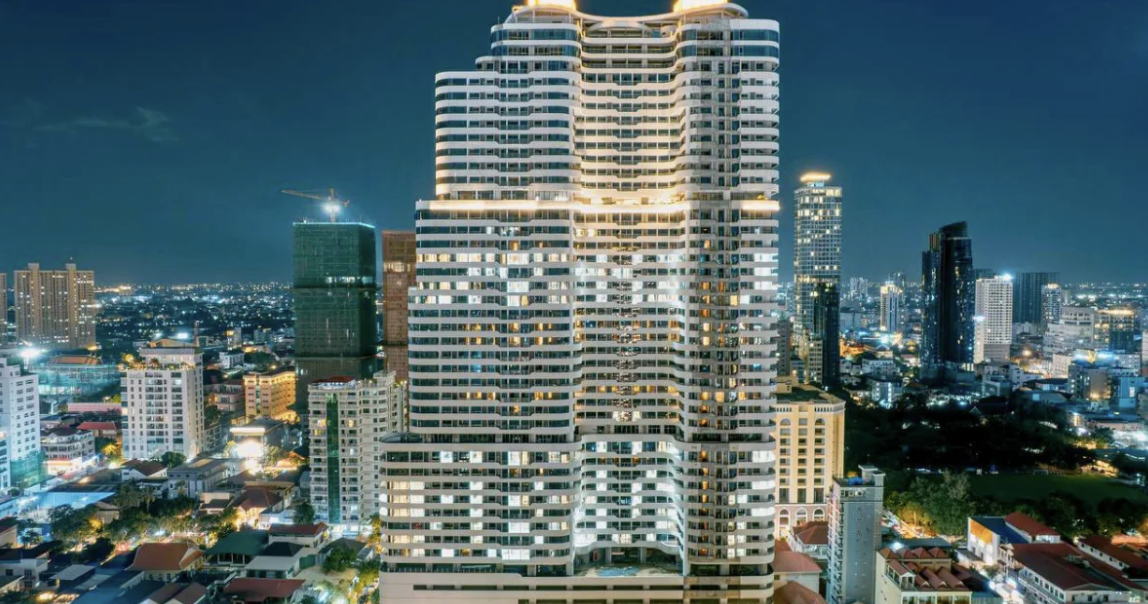
For Commercial Properties in Cambodia, Talk to ANNA ADVISORS!
Author: Anna Araki / ANNA ADVISORS Inc.

Cambodia’s economy is performing well, and land prices are on the rise.
As more foreign companies enter the Cambodian market, demand for commercial properties is increasing alongside residential real estate.
When you hear “investment in commercial properties,” it may sound a little intimidating.
In this article, we will carefully explain the price ranges for commercial properties in Cambodia and introduce a selection of recommended local properties.
We will also cover the costs involved when foreign companies expand into Cambodia, so please read through to the end.
https://youtube.com/watch?v=NN-55KopQaI%3Ffeature%3Doembed%26enablejsapi%3D1%26origin%3Dhttps%3A
Table of Contents
- Cambodia Is Popular Both for Commercial Property Investment and as a Base for Overseas Offices
- 7 Key Advantages of Investing in Cambodian Commercial Properties and Expanding Foreign Businesses
- Rising Land Prices Driven by GDP Growth
- Increasing Number of Commercial Properties, Especially in Phnom Penh
- Relatively Affordable Market Prices for Commercial Properties
- Strong Outlook for Ample Long-Term Labor Supply Thanks to a Young Population
- Non-Residents Can Open Local Bank Accounts
- Ability to Manage Assets in U.S. Dollars
- Geographical Advantage as Part of the Southern Economic Corridor
- 5 Key Points to Note When Investing in Cambodian Commercial Properties or Expanding a Foreign Business
- Recommended Corporate Structure in Cambodia: Private Limited Company
- Estimated Initial Costs for Establishing a Company in Cambodia
- Market Price Ranges for Cambodian Commercial Properties by Type
- 3 Recommended Investment Commercial Properties in Cambodia
- 3 Recommended Local Office Properties in Cambodia
- How ANNA ADVISORS Fully Supports Real Estate Investment and Overseas Expansion in Cambodia
- Conclusion
Cambodia Is Popular Both for Commercial Property Investment and as a Base for Overseas Offices
The Cambodian government is actively promoting foreign direct investment, and capital inflows from abroad are revitalizing the economy.
The country has developed a favorable investment environment for foreign investors, drawing attention not only to residential properties but also to commercial real estate as investment targets.
To simplify incorporation procedures for foreign companies, Cambodia is expanding online application systems and strengthening inter-ministerial coordination—another key feature of its current framework.
The number of companies entering the Cambodian market is increasing year by year, and as of 2022, approximately 1,300 Japanese companies had already expanded into the country (JETEO survey).
Among Japanese businesses, AEON Mall’s three locations in Phnom Penh and the development of Cambodia’s top-tier condominium “J-Tower” series are particularly well-known success stories.
7 Key Advantages of Investing in Cambodian Commercial Properties and Expanding Foreign Businesses
Cambodia offers numerous advantages both for foreign investors entering its real estate market and for foreign companies setting up operations locally.
Below, we explain seven major benefits of investing in Cambodian real estate and expanding your business into Cambodia.
Rising Land Prices Driven by GDP Growth
As the graph below shows, Cambodia has maintained stable GDP growth.
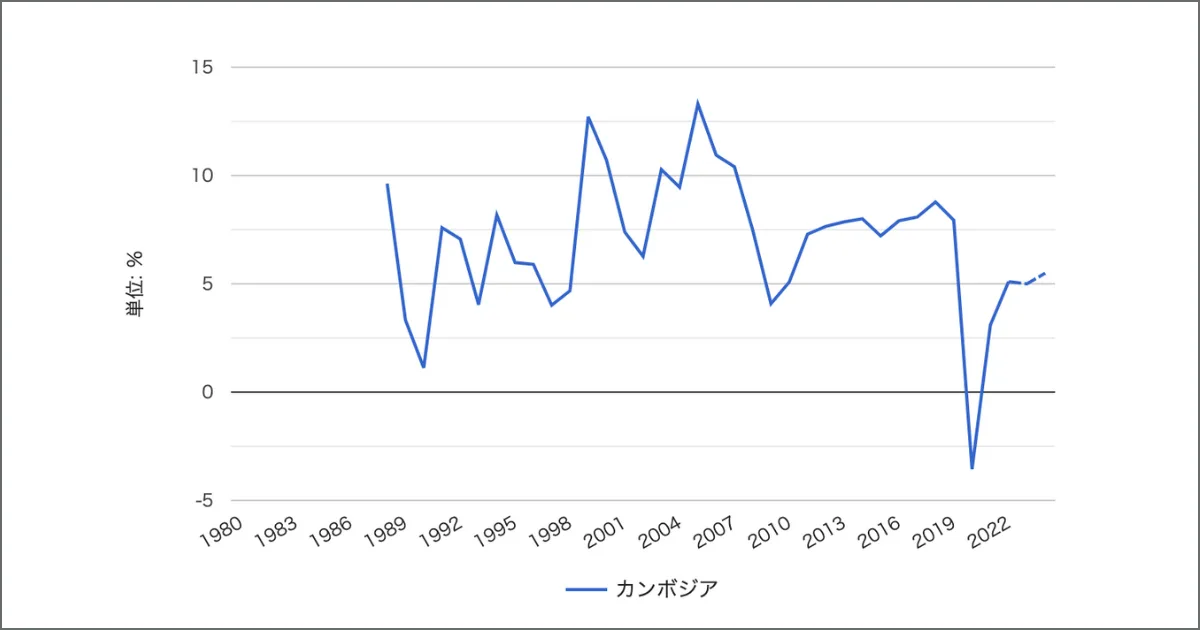
| Year | GDP Growth Rate (YoY) |
|---|---|
| 2019 | 7.94% |
| 2020 | -3.56% |
| 2021 | 3.09% |
| 2022 | 5.10% |
| 2023 | 5.00% |
| 2024 | 5.49% |
Source: “Cambodia Economic Growth Rate Trends,” Sekai Keizai no Neta-chō
Although GDP dipped below the previous year in 2020 due to the impact of COVID-19, it grew year-on-year in all other years.
Along with GDP growth, land and property prices have also risen, making it easier to generate both income gains (rental income) and capital gains (price appreciation).
Increasing Number of Commercial Properties, Especially in Phnom Penh
Driven by robust economic growth, urban development in Cambodia is accelerating, with particularly remarkable progress in and around Phnom Penh.
The greater Phnom Penh area is highly popular both as a tourist destination and as a business hub, and the number of commercial properties such as hotels and offices is increasing.
Cambodia is also collaborating with countries including Japan on Special Economic Zone (SEZ) initiatives, and properties within these SEZs—such as logistics centers—are especially noteworthy.
Relatively Affordable Market Prices for Commercial Properties
Despite its strong economic growth, Cambodia’s real estate prices remain relatively affordable, making it possible to secure properties with relatively low budgets.
For example, when comparing office properties of around 50 m² in Phnom Penh and Tokyo’s Shinjuku Ward, the following price levels can be observed:
- Phnom Penh: Rent USD 550 (USD 1 = JPY 150 → approx. JPY 82,500) / Purchase approx. JPY 26 million
- Shinjuku Ward: Rent approx. JPY 280,000 / Purchase approx. JPY 52 million
Many properties can be acquired at less than half the price of comparable Japanese properties, making it easier to keep running costs under control when operating a business.
Additionally, Cambodia widely adopts a pre-build payment structure, in which property costs are paid in stages. This allows buyers of newly built properties to keep their initial investment relatively low.
Strong Outlook for Ample Long-Term Labor Supply Thanks to a Young Population
As shown in the population graph, the vast majority of Cambodia’s population falls within the working-age bracket (15–64 years).
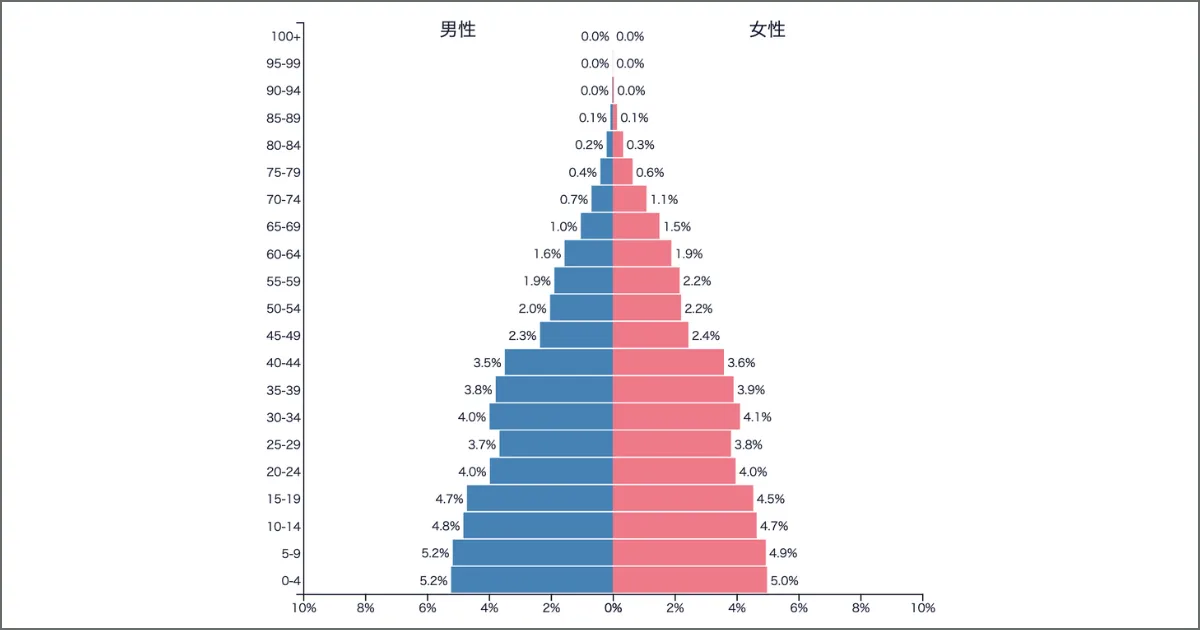
A particularly large proportion of the population is young, which suggests a solid outlook for securing abundant labor over the long term.
This ample labor supply is one of the factors driving Cambodia’s GDP growth, and the ease of hiring young workers is a substantial advantage for companies.
Non-Residents Can Open Local Bank Accounts
In Cambodia, even non-residents can open local bank accounts, and many banks allow account opening procedures to be completed online or by mail.
Minimum deposit requirements are often around USD 100, which makes it possible to open an account with a relatively small amount of capital.
Fixed deposit interest rates are around 4–5%, which is significantly higher than what Japanese banks generally offer, making it possible to earn substantial interest income.
Many banks also provide Japanese-language support, such as through dedicated desks for Japanese customers.
For more details on recommended banks in Cambodia, please refer to our dedicated article on this topic.
Ability to Manage Assets in U.S. Dollars
In most parts of Cambodia, the U.S. dollar is widely circulated and effectively functions as a de facto key currency.
It is the only country in Southeast Asia where day-to-day transactions can be conducted directly in U.S. dollars, and because the dollar has high interchangeability with other currencies, it significantly enhances economic convenience.
Holding assets in U.S. dollars also helps mitigate foreign exchange risk by allowing you to respond flexibly to both yen depreciation and yen appreciation.
Geographical Advantage as Part of the Southern Economic Corridor
Cambodia is located along the Southern Economic Corridor and offers smooth access to Thailand and Vietnam.
The Southern Economic Corridor is a large-scale arterial road network that traverses the southern part of the Indochina Peninsula, established to improve logistical and transportation efficiency.
Bordering key Southeast Asian economies such as Thailand and Vietnam, Cambodia benefits from outstanding geographic accessibility—another major factor behind the country’s development.


5 Key Points to Note When Investing in Cambodian Commercial Properties or Expanding a Foreign Business
Foreign individuals and companies face certain disadvantages when purchasing or leasing commercial properties in Cambodia.
Below, we outline five key points to be aware of when buying commercial properties or expanding your business into Cambodia.
Various Restrictions on Properties That Foreigners Can Purchase
While Cambodia encourages foreign investment and business activities, it also imposes several restrictions on the types of properties that foreigners may purchase:
- Foreign individuals and companies can only purchase buildings completed in 2010 or later
- Foreign individuals and companies may only purchase apartment/condominium units or commercial properties
- Foreign individuals and companies may only purchase floors on the second level or above of a building
- The total area that foreigners may own in a single building is capped at 70% of the total floor area (combined total for all foreign individuals and companies)
- Foreign individuals and companies may only purchase properties located at least 30 km away from national borders
If a property you wish to purchase does not satisfy these conditions, you will not be allowed to acquire it—so it is essential to verify eligibility in advance.
As a general rule, foreigners are not allowed to own land in Cambodia; however, land ownership is possible if certain conditions are met.
For more details on land ownership in Cambodia, please refer to our dedicated article.
Vulnerability in Power Supply
Cambodia’s domestic power generation capacity is insufficient to fully meet national demand, and a substantial portion of electricity needs is covered by imports from Thailand and Vietnam.
Because of these import costs, electricity prices tend to be relatively high, especially in urban areas located far from power plants.
Furthermore, the domestic power grid is not yet fully developed, so outages occur relatively frequently.
This instability in power supply can cause inconvenience both for business operations and daily life.
Differences in Values Between Japanese and Cambodians
Although Cambodians are known for being kind and friendly, their attitudes and behavior can sometimes feel “loose” from a Japanese perspective. Common examples include:
- Punctuality: Tardiness of around 30 minutes to 1 hour is not unusual; sometimes people forget appointments entirely
- Job Changes: Workers often switch jobs easily if a better offer appears, regardless of length of service; some may change jobs repeatedly within a month
- Absenteeism: Employees may call in absent on the day itself with various excuses, sometimes repeatedly citing bereavement leave for the same relative
Of course, this does not apply to all Cambodians. However, based on Ms. Araki’s experience employing local staff, these tendencies are broadly observable.
Compared to Japanese standards, it is difficult to say that business literacy is high on average in Cambodia, and there is potential for friction with Japanese employees due to these differences in values.
Overall Insufficiency in Property Management Systems
The business-related “looseness” often perceived in Cambodian workers can also be seen in property management practices.
At locally run management companies, cleaning, maintenance, and other property management tasks may sometimes be neglected.
When maintenance is insufficient, buildings deteriorate faster, and negative word-of-mouth about the property can spread easily.
Physical deterioration leads to lower property valuations, and negative reviews can negatively impact occupancy rates.
To ensure our clients can invest and reside with peace of mind, our company also dedicates significant effort to property management services following purchase.
Existence of Scams Targeting Foreigners
While Cambodia’s macroeconomic conditions are strong and foreign investment is active, there are also scams that specifically target foreign investors.
In recent years, these scams have become increasingly sophisticated, and there have been cases where even experienced investors fail to recognize them as fraud.
Japanese nationals are generally perceived as wealthy and therefore are often targeted.
In some cases, Japanese scammers exploit the sense of security that comes with dealing with “fellow Japanese,” so it is best to avoid trusting someone solely because they share your nationality.
For more details on real estate investment scams in Cambodia and abroad, please refer to our dedicated article.
Recommended Corporate Structure in Cambodia: Private Limited Company
For foreign companies establishing a presence in Cambodia, we recommend a private limited company as the preferred corporate structure.
A private limited company does not list its shares on a stock exchange, and shareholders’ liability is limited to the amount of their capital contribution.
Because management policies are less easily influenced by third parties and liabilities are capped, private limited companies enable a high degree of freedom while keeping business risks relatively low.
By contrast, a public limited company is the opposite type of structure.
In a public limited company, shares are listed on a stock exchange to raise capital, making it easier to gather large amounts of funding. However, shareholders with large ownership stakes tend to wield significant influence, which can be a disadvantage.
While sole proprietorships offer simple procedures for starting a business, please note that there is no limit to the scope of personal liability for debts.
For more details on company incorporation in Cambodia, please refer to our dedicated article.
Estimated Initial Costs for Establishing a Company in Cambodia
The estimated initial costs for establishing a company in Cambodia are shown in the table below.
| Cost Item | Amount (USD) | Ministry / Authority | Description |
|---|---|---|---|
| Capital | 1,000– | – | Minimum required capital to establish a company |
| Trade Name Reservation | 6.25 | Ministry of Commerce | Temporary reservation of company name |
| Trade Name Registration | 252.5 | Ministry of Commerce | Official registration of company name |
| Taxpayer Registration | 100 | General Department of Taxation | Tax registration fee |
| Patent Tax Registration | 50–375 | General Department of Taxation | Business tax, varies by business size |
| Business Establishment Notice | 30 | Ministry of Labour and Vocational Training | Declaration for opening a business & employing foreigners |
| Company Ledger Registration | 20 | Ministry of Labour and Vocational Training | Registration fee for supervisory audit ledger |
| Payroll Ledger Registration | 20 | Ministry of Labour and Vocational Training | Registration fee for employee payroll ledger |
| Bank Account Certificate | 10 | Bank / General Department of Taxation | Fee for documents required to open a business account |
| Total | 1,163.75–1,488.75 |
Patent tax is categorized by business size as follows: Small: USD 50, Medium: USD 150, Large: USD 375
The above figures are estimates and may change due to revisions in Cambodian law or international conditions
Assuming an exchange rate of USD 1 = JPY 150, the initial cost to establish a company in Cambodia is approximately JPY 170,000–220,000.
Because many procedures can be completed online and total costs are not very high, we can say that the barrier to company formation in Cambodia is relatively low.
However, Japanese cannot generally be used for these procedures, and some documents must be prepared in English, which can create language-related challenges.
In addition to brokering local offices and residential properties, our company can assist with procuring office equipment and fixtures, and can introduce lawyers and tax accountants who specialize in company formation and corporate accounting.
For small-scale businesses, our support fees typically range from USD 3,000–5,000 (USD 1 = JPY 150 → approx. JPY 450,000–750,000), and we offer comprehensive coordination for foreign companies entering the Cambodian market.

Market Price Ranges for Cambodian Commercial Properties by Type
When contracting commercial properties in Cambodia, the options broadly fall into rental and purchase.
For sole proprietors, it is also common to use their home as a combined residential and office space.
Below, we outline typical price ranges for commercial properties in each of these scenarios.
The market prices quoted here refer to properties in and around Phnom Penh, where the number of contracts signed by foreigners is highest.
Rental: Approx. JPY 100,000–200,000 for a Standard Office
In the Phnom Penh area, the typical monthly rent for a standard office of around 50 m² is approximately USD 500–600, meaning that at an exchange rate of USD 1 = JPY 150, there are properties available for under JPY 100,000 per month.
Many of these offices offer convenient access to government offices and commercial facilities.
Street-level retail spaces of about 50 m² typically rent for around USD 1,000–2,000 per month (USD 1 = JPY 150 → approx. JPY 150,000–300,000).
Tenant spaces in large commercial facilities and prominent properties can offer strong customer-drawing power, but entry screening is often rigorous, and rents tend to be higher.
Warehouse rentals are also available. Monthly rents for these properties are typically USD 2,000–3,000 (USD 1 = JPY 150 → approx. JPY 300,000–450,000), which is higher than other types of properties, but the average floor area is a spacious 600–1,000 m².
Purchase: Many Properties in the JPY 10–20 Million Range
In and around Phnom Penh, there are many office properties available for purchase in the JPY 10–20 million range.
Some properties come with office space, toilets, and additional amenities such as shower booths, making them suitable for use as retail stores.
Although large office buildings command higher prices, they usually feature well-equipped facilities and functions, making them highly popular among foreign companies.
Investors can also earn returns by purchasing commercial properties and then renting them out or selling them.
Sole Proprietorship: Abundant Condominiums That Can Double as Offices
Sole proprietors conducting business in Cambodia can rent or purchase condominiums and use them as combined residential and office spaces.
The Phnom Penh area has a wide range of condominiums, making it easy to find properties that match your budget.
However, some property owners do not allow residential properties to be used as offices, so this needs to be checked in advance.
If you prefer not to register your company using your home address, you can also use the address of a virtual office for corporate registration.
Typical monthly fees for virtual offices in Cambodia are around JPY 10,000, which usually includes not only address use but also services such as obtaining a dedicated email address.
3 Recommended Investment Commercial Properties in Cambodia
Many properties are available in Cambodia, particularly in and around Phnom Penh.
Below, we introduce three properties that are especially well suited for investment.
Flatiron: Attractive Office Property with Buyback Guarantee
Flatiron is an office and apartment hotel located at the heart of one of Cambodia’s emerging business districts.
This high-rise building has one basement floor and 42 above-ground floors and is fully equipped with facilities essential for business, including an underground car park, offices, hotel, restaurants, and lounges.
Major domestic banks are clustered in the surrounding area, and large office complexes such as Exchange Square are only a 5–10 minute drive away.
The building enjoys a high occupancy rate from capital-rich foreign companies, including many Japanese firms, and some of the units we handle come with a buyback guarantee.
Vue Aston: Hotel Floors Exclusively Brokered by ANNA ADVISORS
Vue Aston is a hotel condominium that offers sweeping views of the Mekong River and Bassac River. Its facilities include shared office spaces, meeting rooms, a pool, a gym, and more.
In addition to its exceptional views, the property features five indoor gardens, making it one of Cambodia’s most aesthetically and architecturally refined developments.
We hold an exclusive brokerage mandate for the hotel floors in this property and work in partnership with a management company that operates over 40,000 rooms worldwide, including in Japan. This ensures top-tier maintenance and management.
The units we handle start at around USD 130,000, and we offer a 10-year guaranteed average yield of 8.5%, as well as an optional buyback program—extremely attractive terms for investors.
Zhan Su by Meridian: Significant Returns Expected in the Special Economic Zone
Zhan Su by Meridian is a property consisting of factory and land lease assets located within one of Cambodia’s Special Economic Zones (SEZs).
Under a government-led initiative, Cambodia is actively developing SEZs, and this property is part of a large-scale project in one such zone.
On a vast site of approximately 10,000 m², around 4,000 m² of factories and related facilities have been constructed, and the property is expected to play a central role in domestic industry, backed by Cambodia’s abundant labor force.
The portion we handle offers a 7.5% rental income guarantee, and based on detailed financial simulations, we estimate a projected investor return of approximately USD 13 million after five years.
3 Recommended Local Office Properties in Cambodia
Office properties are plentiful in Cambodia, especially in Phnom Penh, and large office buildings are especially popular with foreign companies thanks to their strong brand image and comfortable working environments.
Below, we highlight three particularly recommended office properties for companies entering the Cambodian market.
Exchange Square: High-Tech Property with an Independent Power Supply System
Exchange Square combines a 16-storey office tower with four floors of retail space, offering a total floor area of over 18,000 m².
Developed by a major Hong Kong-based real estate developer, this mixed-use complex features stylish tenant spaces that house brand-name stores, fashionable cafés, and restaurants.
The office floors utilize an independent power generation system, ensuring a stable power supply, and security measures throughout the building are thorough.
Thanks to its convenient location—about 45 minutes from Phnom Penh International Airport—it has become a central business hub popular among foreign enterprises.
Vattanac Capital Tower: Landmark Skyscraper Popular as a Tourist Spot
Vattanac Capital Tower is one of Cambodia’s tallest mixed-use buildings, rising 39 storeys and 188 meters high in central Phnom Penh.
It houses a hotel and shopping mall, and its distinctive shape—often likened to a “penguin”—has made it an iconic landmark and tourist attraction.
With facilities such as co-working spaces and rent plans that include utility costs, the property caters to a wide variety of business needs.
It is widely recognized as one of the finest mixed-use developments in Cambodia and enjoys strong popularity among Japanese, European, and American companies.
Sathapana Bank Tower: Large Office Property Owned by a Major Domestic Bank
Sathapana Bank Tower is a high-rise office building with four basement levels and 22 above-ground floors, serving as the headquarters for one of Cambodia’s major banks, Sathapana Bank.
Sathapana Bank traces its origins to the Japanese-owned Maruhan Japan Bank and adopted its current structure after merging with a major Cambodian financial institution in 2016.
Jointly developed by the Maruhan Group and a Korean company, Sathapana Bank Tower has received world-class Grade A certification.
With the bank itself housed in the building, it offers extremely fast and flexible financial transaction capabilities, making it highly attractive for companies that value efficient capital management.
How ANNA ADVISORS Fully Supports Real Estate Investment and Overseas Expansion in Cambodia
Our company supports overseas real estate investment and asset-building through foreign bank account openings, with a particular focus on Cambodia.
We also offer extensive services for companies planning to expand into Cambodia.
With offices in both Tokyo and Phnom Penh, we can support clients seamlessly from both countries.
Below, we explain our main service lines in greater detail.
Investment: Comprehensive Asset-Building Support Including Cambodian Bank Account Opening
We broker Cambodian real estate for both individual and corporate clients.
Since our founding, we have built an extensive track record in real estate brokerage, and we also handle exclusive properties within Cambodia.
In addition to real estate investment, we support bank account opening and help clients build assets more efficiently by using high-yield bank deposits alongside property investments.
We place great emphasis on after-sales support following real estate transactions and account openings, supporting clients’ asset-building over the long term.
We actively host domestic seminars and on-site tours related to Cambodian real estate investment and bank account opening, so please feel free to join us.
For busy or distant clients, we also provide online real estate brokerage and account opening support.
Overseas Expansion: End-to-End Coordination Including Property Brokerage and Introduction to Lawyers and Tax Accountants
Our company was founded in Cambodia by our CEO, Ms. Araki, and we have been operating in the country for over a decade.
Drawing on our own experience of incorporation and operation in Cambodia, we actively support other companies expanding into the market.
In addition to brokering commercial and residential properties, we can arrange office equipment and fixtures and introduce experienced lawyers and tax accountants.
We specialize in brokering high-grade properties in and around Phnom Penh, and our highly functional and convenient commercial properties are well regarded by many Japanese companies.
We typically support corporate entry into Cambodia from around USD 3,000–5,000 (USD 1 = JPY 150 → approx. JPY 450,000–750,000) for small-scale businesses.
From company incorporation to financial management, we offer end-to-end coordination for your expansion into Cambodia—please leave it to us.
Conclusion
Cambodia’s economic growth is accelerating, and the number of foreign companies entering the market is steadily rising. Commercial properties are also very popular among foreign investors.
Despite strong macroeconomic performance, land prices remain relatively low, and expected yields are high, making it an attractive environment for entering the real estate investment market.
Because company registration costs are modest and commercial property prices are relatively low, conditions are generally favorable for foreign companies looking to launch or expand their business operations.
We broker a wide range of commercial properties suitable for both investment and actual business use.
Our services are designed to provide comprehensive support for both corporate market entry and long-term asset-building by individual investors.
We would be honored to be your trusted partner for investment and business expansion in Cambodia.