Obtain Permanent Residency in Cambodia!
Thorough Guide to the Requirements for Permanent Residency and Recommended Migration Destinations in Southeast Asia
Author: Anna Araki / Anna Advisors Co., Ltd.

Cambodia is experiencing remarkable economic growth and is becoming an increasingly popular destination for people relocating from overseas.
In addition to economic factors, there are also many migrants and permanent residents who are attracted by its unique culture and climate, making it one of the countries that is relatively easy to move to or settle in from Japan.
In this article, we will explain in detail why Cambodia is suitable for migration and permanent residency, as well as the conditions for obtaining permanent residency in Cambodia.
We will also introduce other recommended migration destinations in Southeast Asia besides Cambodia, so please stay with us until the end.
Table of Contents
- 7 Reasons Why We Recommend Moving to or Permanently Residing in Cambodia
- Living costs can be kept lower than in Japan
- Lower tax rates than Japan make it easier to reduce your tax burden
- Active urban development and strong future potential
- Properties can be rented or purchased at relatively low prices
- Bank accounts are highly convenient and easy to use from overseas
- Many people are pro-Japanese and friendly
- The food suits Japanese tastes
- 5 Drawbacks When Moving to or Settling Permanently in Cambodia
- Multiple Types of Visas for Moving to or Permanently Residing in Cambodia
- Why a Business Visa Is Recommended for Moving to or Permanently Residing in Cambodia
- Other Southeast Asian Countries That Are Attractive as Migration Destinations
- 3 Effective Media for Learning About Local Conditions
- YouTube | Many creators, both individuals and companies
- Summary
7 Reasons Why We Recommend Moving to or Permanently Residing in Cambodia
Cambodia is, for various reasons, a country well suited to relocation or permanent residence.
Below, we will explain seven reasons why Cambodia is suitable for migration and permanent residency.
Living costs can be kept lower than in Japan
Prices in Cambodia are generally lower than in Japan, making it easier to keep living costs under control.
The table below compares the average prices of everyday items in Phnom Penh and Tokyo.
| Item | Average Price (Phnom Penh, JPY) | Average Price in Tokyo (JPY) | Ratio vs. Tokyo |
|---|---|---|---|
| Inexpensive restaurant meal | 774 yen | 1,000 yen | 77% |
| Meal for 2–3 people at a mid-range restaurant | 4,643 yen | 7,000 yen | 66% |
| McDonald’s value meal | 1,083 yen | 800 yen | 135% |
| Domestic draft beer (500ml) | 155 yen | 500 yen | 31% |
| Cappuccino (regular) | 452 yen | 490 yen | 92% |
| Coca-Cola (330ml bottle) | 150 yen | 173 yen | 87% |
| Water (330ml bottle) | 141 yen | 115 yen | 122% |
| Bottle of wine | 1,857 yen | 1,100 yen | 169% |
| Cigarettes (Marlboro, pack of 20) | 271 yen | 600 yen | 45% |
| Milk (1 liter) | 334 yen | 233 yen | 143% |
| Loaf of bread (500g) | 306 yen | 267 yen | 115% |
| White rice (1kg) | 153 yen | 494 yen | 31% |
| Chicken breast/fillet (1kg) | 678 yen | 1,079 yen | 63% |
| Beef round (1kg) | 1,594 yen | 3,072 yen | 52% |
| Apples (1kg) | 692 yen | 813 yen | 85% |
| Bananas (1kg) | 300 yen | 383 yen | 78% |
| Tomatoes (1kg) | 231 yen | 731 yen | 32% |
| Potatoes (1kg) | 243 yen | 424 yen | 57% |
| Lettuce (1 head) | 280 yen | 209 yen | 134% |
| One-way local transport ticket | 155 yen | 200 yen | 77% |
| Taxi (1km, normal tariff) | 155 yen | 420 yen | 37% |
| Gasoline (1 liter) | 183 yen | 173 yen | 106% |
| Utilities for 85㎡ apartment (electricity, etc.) | 16,986 yen | 27,429 yen | 62% |
| Mobile plan with calls + 10GB data (per month) | 916 yen | 3,822 yen | 24% |
| Internet (60 Mbps or more, unlimited data) | 4,767 yen | 4,853 yen | 98% |
| Fitness club membership (1 adult, monthly) | 7,643 yen | 9,043 yen | 85% |
| Jeans (e.g., Levi’s 501) | 3,715 yen | 7,692 yen | 48% |
| Summer dress (e.g., ZARA) | 3,515 yen | 5,355 yen | 66% |
| Men’s business shoes | 9,199 yen | 11,890 yen | 77% |
| Kindergarten (full day, monthly, 1 child) | 55,205 yen | 75,650 yen | 73% |
| International primary school (annual, 1 child) | 2,107,040 yen | 2,267,353 yen | 93% |
| Apartment in city center (1-bedroom, monthly rent) | 77,063 yen | 149,682 yen | 51% |
| Price per m² to buy apartment in city center | 353,827 yen | 1,236,979 yen | 29% |
| Mortgage interest rate (20-year fixed) | 11.0% per year | 1.69% per year | 651% |
Source: NUMBEO “Cost of Living (Cambodia) 2024”
In Phnom Penh, prices are lower than Tokyo for almost all items. In particular, apartment rents are about half those in Japan, while purchase prices are roughly one-third, making them extremely inexpensive.
Since housing-related costs form a major fixed component of living expenses, keeping them low makes it easier to maintain a comfortable lifestyle with more financial leeway.
Lower tax rates than Japan make it easier to reduce your tax burden
Compared with Japan, Cambodia is characterized by lower taxes on individuals and corporations, such as income tax and corporate tax.
Although income tax is progressive, as in Japan, Japan’s income tax rate ranges from 5% to 45%, whereas Cambodia’s ranges from 0% to 25%, with both the upper and lower limits being lower.
Corporate tax is also lower: Japan’s standard rate is 23.2%, while Cambodia’s standard rate is 20%.
Because tax rates on income and sales are low, large-scale businesses and high-income earners, in particular, benefit significantly from potential tax savings.
As mentioned in the section on living costs, Cambodia also has lower taxes on alcohol, tobacco, and other “sin goods” compared with Japan.
This means that people who enjoy drinking or smoking can also keep their living expenses relatively low.
Active urban development and strong future potential
Cambodia’s GDP growth rate has exceeded the previous year almost every year. In recent years, Cambodia’s GDP has evolved as follows:
- 2021: +3.09% year-on-year
- 2022: +5.10% year-on-year
- 2023: +5.00% year-on-year
- 2024: +5.49% year-on-year
Source: IMF – World Economic Outlook Databases (October 2024)
Along with solid domestic economic growth, urban development has progressed, with particularly remarkable development around Phnom Penh.
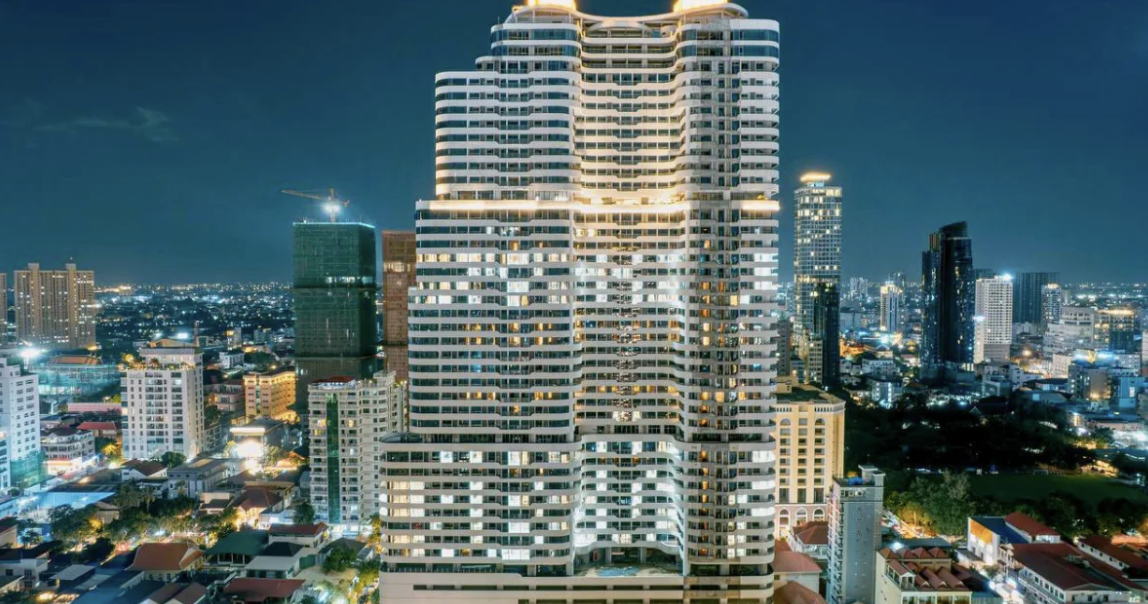
Within Phnom Penh, luxury condominiums line the streets, and development of hotels and large-scale commercial facilities is ongoing, with urban functions continuing to expand.
In addition, a new international airport is scheduled for completion during 2025, and expectations are high for improved accessibility.
Properties can be rented or purchased at relatively low prices
As mentioned above, the going rate for housing in Cambodia is significantly lower than in Japan.
Although rents vary depending on factors such as building age, facilities, and total floor area, the approximate monthly rent for a two-bedroom unit in Phnom Penh, Bangkok (Thailand), and Shinjuku (Tokyo) is as follows:
- Phnom Penh: USD 450–2,500
(at 1 USD = 150 JPY, approx. 67,500–375,000 yen) - Bangkok: 20,000–180,000 baht
(at 1 baht = 4 JPY, approx. 80,000–720,000 yen) - Shinjuku: 130,000–1,530,000 yen
As the price comparison above shows, the lowest rents in Phnom Penh are about half those in Shinjuku.
Even for lower-rent properties, facilities such as pools and fitness gyms may be included, so in some cases you may find them more comfortable than properties in Japan.
Bank accounts are highly convenient and easy to use from overseas
In Cambodia, the US dollar is widely used throughout most of the country and is commonly used for everyday purchases and bank deposits.
Thanks to strong domestic economic growth, time deposits at Cambodian banks offer very high average interest rates, at around 4–5%.
Non-residents can also open and hold bank accounts, so you can continue using your Cambodian bank account even after moving to another country.
Because you can hold assets in US dollars, it is also a major advantage in terms of hedging against foreign exchange risk.
For recommended banks in Cambodia, we provide more detail in a separate article.
Many people are pro-Japanese and friendly
Cambodians are generally very fond of Japan, and the national character tends to be friendly and kind.
Japan’s active economic and technical support for Cambodia is widely known within the country, and this is one of the reasons why Cambodians often feel a sense of closeness to Japan.
Many people are both friendly and polite, making interaction at an appropriate distance relatively easy.
I, Araki, as well as our staff, are greatly attracted to the Cambodian national character, and we hope that by operating our business in Cambodia, we can make a modest contribution to the country’s development.
The food suits Japanese tastes
Just like national character, food has a major impact on the quality of your stay in a country.
Cambodian cuisine is characterized by natural flavors with relatively little oil and spice, and is said to suit Japanese tastes well.
The meals served at restaurants during our company’s local tours are also very well received by participants.
There are many Japanese restaurants in the country, and Japanese chains such as Watami and Yoshinoya also have outlets here.
A wide variety of alcoholic beverages, including beer, are available at low prices, so those who enjoy drinking are likely to be very satisfied as well.


5 Drawbacks When Moving to or Settling Permanently in Cambodia
There are, of course, some drawbacks to moving to or permanently residing in Cambodia.
Here, we will explain five disadvantages that tend to arise when migrating to or settling in Cambodia.
Concerns about the stability of power supply
Cambodia’s domestic power generation is not sufficient to meet demand, and the country relies heavily on imported electricity from Thailand and Vietnam.
Because of added import costs, electricity bills tend to be high, and especially in urban areas far from power plants, they can be even higher.
Since the transmission network is not fully developed, there is also the disadvantage that blackouts occur relatively frequently.
In modern life, which relies heavily on electricity, this fragility of power supply can cause considerable inconvenience.
Cases of fraud targeting foreigners
There have been reports of fraud schemes in Cambodia targeting foreigners.
In the real estate sector, foreign investors—who are often unfamiliar with local conditions and whose situation is harder to monitor—are frequent targets, and there are cases of sophisticated scams that deceive even experienced investors.
When purchasing newly built properties in Cambodia, it is not uncommon for projects to remain unfinished due to financial problems or bankruptcy of the developer.
It is possible to open a Cambodian bank account through individual agents, but many do not provide after-sales support, so it is safer to avoid opening accounts through individuals.
One common line you may hear from local Cambodians is: “I’m close to high-ranking government officials, so I can get you a better deal.” You should avoid taking such claims at face value and entrusting them with your funds.
Persistent corruption involving public authorities
In some respects, public authorities in Cambodia cannot be said to be functioning properly. There are cases where corruption by officials and police affects foreigners, such as:
- A foreigner being asked for a bribe by an official in exchange for issuing a property title deed
- A foreigner having a traffic offense fabricated by a police officer and being forced to pay an unjust fine
Corruption involving public authorities is, in effect, widespread and semi-open.
In the 2024 Corruption Perceptions Index, Cambodia was considered a country with a high level of corruption.
The index uses a maximum score of 100, with higher numbers indicating less corruption. Cambodia’s score was 21, ranking 158th out of 180 countries surveyed, which is a fairly low position.
The Hun Manet administration regards domestic corruption as a serious problem and is working to strengthen legal frameworks aimed at eradicating and strictly punishing corruption.
A tendency for petty crime to occur
Although serious violent crimes are relatively rare in Cambodia, petty crimes such as snatch theft, pickpocketing, and theft of unattended belongings occur quite frequently.
The following statistics show the number of crimes that occurred in Cambodia between January and March 2023.
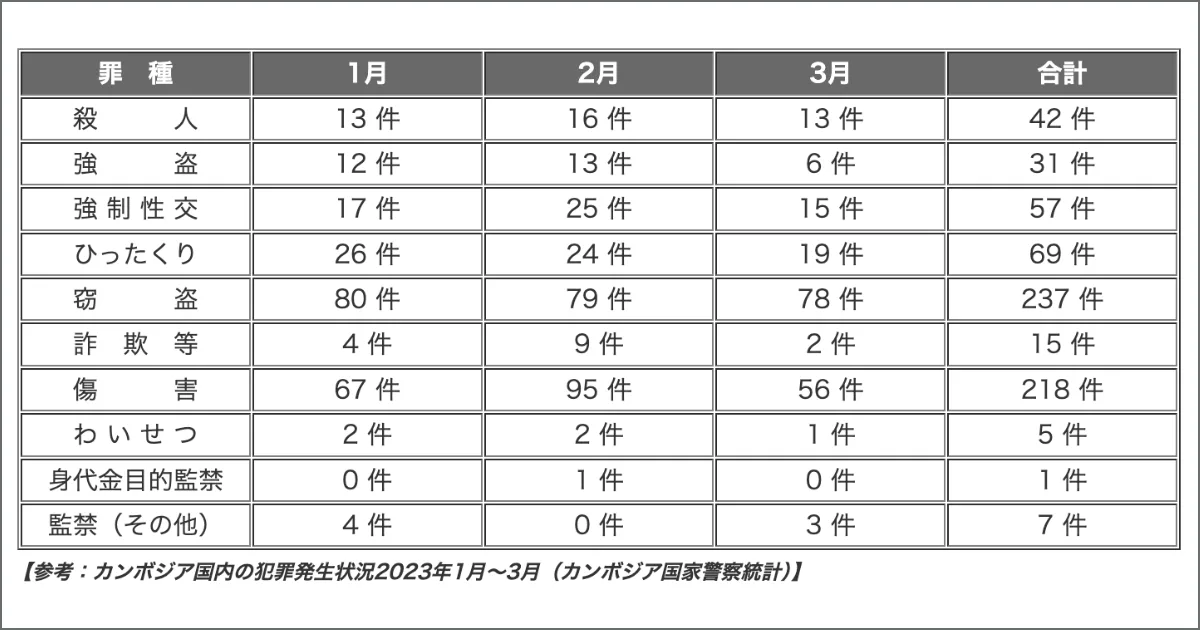
Source: Embassy of Japan in Cambodia, “Overseas Safety Information”
According to the statistics, crimes involving Japanese victims included five cases of snatch theft, two cases of theft, and one case of robbery using stupefying drugs.
In such robberies, the common method is to approach the target in a friendly manner, lace food or drink with sleeping pills to render them unconscious, and then steal their money and valuables.
Tourists and foreigners are often targeted for such crimes, so particular caution is needed with people who are overly friendly or members of the opposite sex who behave in an overly seductive manner.
There are also cases in which Japanese nationals are believed to be involved in such criminal groups, so you should avoid trusting someone immediately just because they are “also Japanese.”
In Cambodia, it is widely recognized that Japanese people are relatively affluent and have high income levels, so there is a comparatively high likelihood of being targeted, which calls for extra vigilance.
Poor traffic manners in some cases
Overall traffic manners in Cambodia cannot be described as good, and traffic violations are common.
Many drivers engage in selfish driving behaviors such as running red lights or changing lanes abruptly, so great caution is needed.
Dangerous acts such as drunk driving and driving without a license are also frequently observed, but police enforcement is lax, and traffic offenses are often left unchecked.
As mentioned earlier, there are also many cases where police officers fabricate traffic violations by foreigners and embezzle the unjust fines collected from them, so this is another area where caution is required.
Multiple Types of Visas for Moving to or Permanently Residing in Cambodia
Cambodia offers several types of visas for migrants.
In this section, we will explain the visas available for those wishing to move to Cambodia.
Depending on the visa, it may also be possible to obtain permanent residency, subject to certain conditions.
Multiple Types of Visas for Moving to or Permanently Residing in Cambodia
Cambodia offers several types of visas for migrants.
In this section, we will explain the visas available for those wishing to move to Cambodia.
Depending on the visa, it may also be possible to obtain permanent residency, subject to certain conditions.
Job-Seeker Visa | A visa suitable for job hunting in Cambodia
A job-seeker visa is issued to foreigners who intend to look for work in Cambodia. The maximum validity period is six months, and you should be aware that it cannot necessarily be renewed.
The initial application fee is the same as for a business visa: USD 35 (at 1 USD = 150 JPY, approx. 5,250 yen).
After obtaining a business visa, you must then convert it to a job-seeker visa at the Japanese Embassy in Cambodia.
Retirement Visa | A visa for a second life from your 50s onward
A retirement visa is issued to individuals aged 55 or older or to pension recipients.
To obtain a retirement visa, it is said that you need to have savings sufficient to live in the country for about one year, although no specific amount is clearly defined.
Note that you cannot work in Cambodia using a retirement visa.
You must first obtain a business visa and then convert it to a retirement visa. This visa can be renewed for one-year periods.
Golden Visa | An investor visa that allows you to obtain permanent residency
The Golden Visa, also known as an investment visa, is a new type of visa that was introduced in 2022.
It is characterized by a very long validity period of 10 years, and because you can obtain Cambodian citizenship five years after issuance, it is a visa that tends to lead to permanent residency.
To obtain it, you must become a member of “CM2H (Cambodia My Second Home)” and invest at least USD 50,000 (at 1 USD = 150 JPY, 15 million yen, as stated in the original text) in Cambodia.
The CM2H membership fee is USD 50,000, so a total of USD 100,000 is required.
Although you need a lump sum of more than around 10 million yen, it is attracting attention as a visa that can ultimately lead to obtaining permanent residency (Cambodian nationality).
Golden Visa | An investor visa that allows you to obtain permanent residency
The Golden Visa, also known as an investment visa, is a new type of visa that was introduced in 2022.
It is characterized by a very long validity period of 10 years, and because you can obtain Cambodian citizenship five years after issuance, it is a visa that tends to lead to permanent residency.
To obtain it, you must become a member of “CM2H (Cambodia My Second Home)” and invest at least USD 50,000 (at 1 USD = 150 JPY, 15 million yen, as stated in the original text) in Cambodia.
The CM2H membership fee is USD 50,000, so a total of USD 100,000 is required.
Although you need a lump sum of more than around 10 million yen, it is attracting attention as a visa that can ultimately lead to obtaining permanent residency (Cambodian nationality).

Other Southeast Asian Countries That Are Attractive as Migration Destinations
Cambodia is certainly an easy country to move to or settle in permanently, but there are many other attractive migration destinations in Southeast Asia as well.
Here, we will introduce recommended countries in Southeast Asia other than Cambodia as options for relocation.
All of these countries are close to Japan, making travel to and from Japan relatively convenient.
Malaysia | A multi-ethnic, multicultural country with many immigrants
Malaysia is a multi-ethnic country composed of Malays, Chinese, Indians, and other groups, and is also a multicultural country where diverse cultures intermingle.
Malaysia’s economic growth has been driven by industries such as manufacturing (electronics) and agriculture/forestry (natural rubber, palm oil, etc.), and urban functions are expanding, particularly in the capital city of Kuala Lumpur.
While industry is developing, the country also boasts abundant nature, including tropical rainforests and beaches, and tourism is thriving.
Major visa types available in Malaysia include the following:
| Visa Type / Name | Requirements | Validity Period |
|---|---|---|
| Residence Pass | Through an employer | Up to 10 years |
| Student Visa | Through an educational institution | Up to 2 years |
| Malaysia My Second Home (MM2H) | Open a fixed deposit account in Malaysia (with deposit conditions) | Up to 10 years |
| Premium Visa Programme (PVIP) | Open a fixed deposit account in Malaysia (with deposit conditions) | Up to 20 years (extendable for another 20 years) |
By opening a fixed deposit account in Malaysia, you can obtain visas that allow long-term stays. Required deposit amounts for each visa include the following:
- Malaysia My Second Home: age 35 or older with a minimum deposit of 1.5 million ringgit
(at 1 ringgit = 32 JPY, approx. 48 million yen), etc. - Premium Visa Programme: a fixed deposit of 1 million ringgit
(at 1 ringgit = 32 JPY, approx. 32 million yen), plus proof of income of 40,000 ringgit per month (at 1 ringgit = 32 JPY, 1.28 million yen) or 480,000 ringgit per year (at 1 ringgit = 32 JPY, 15.36 million yen).
The Premium Visa Programme allows effectively permanent residence, with a 20-year validity and the possibility of a further 20-year extension, but the screening criteria are strict, including requirements such as a certificate of no criminal record.
Indonesia | A DX-advanced country with attractive low living costs
Indonesia’s main industries include manufacturing, wholesale and retail, and agriculture, forestry, and fisheries. It ranks first in nominal GDP among ASEAN countries.
The country is home to many resorts such as Bali and numerous historic temples, making it a popular tourist and resort destination, and the low cost of living is also attractive.
In recent years, digital transformation (DX)-related industries have grown rapidly, and the convenience of everyday life has improved dramatically; for example, you can arrange taxis, deliveries, and babysitters with just a smartphone.
Major visas available in Indonesia include:
| Visa Type / Name | Requirements | Validity Period |
|---|---|---|
| Tourist Visa | Tourism | Up to 60 days |
| Business Visa | Through an employer | 1 year |
| Golden Visa | Establish a local company or make personal investments (amounts required) | Up to 10 years |
| Permanent Stay Permit (KITAP) | Obtain a limited stay permit (KITAS) + pay application fee | Unlimited (renew every 5 years) |
The Golden Visa allows long-term stays of up to 10 years. For individual investors, conditions include:
- When establishing a local corporation:
- 5-year visa with capital of USD 2.5 million
(at 1 USD = 150 JPY, 375 million yen) - 10-year visa with capital of USD 5 million
(at 1 USD = 150 JPY, 750 million yen)
- 5-year visa with capital of USD 2.5 million
- When not establishing a local corporation (purchasing Indonesian government bonds, shares, etc.):
- 5-year visa with investment of USD 350,000
(at 1 USD = 150 JPY, 52.5 million yen) - 10-year visa with investment of USD 700,000
(at 1 USD = 150 JPY, 105 million yen)
- 5-year visa with investment of USD 350,000
The Permanent Stay Permit (KITAP) can be obtained after first acquiring a limited stay permit (KITAS) and paying a fee of roughly 5 million rupiah
(at 1 rupiah = 0.008 JPY, about 40,000 yen), so the hurdle for obtaining it is relatively low.
The Philippines | An emerging country highly popular among Japanese
The Philippines’ main industries include call center/BPO services and various manufacturing sectors. It is easily accessible from Japan and is one of the countries that Japanese people tend to find familiar.
English is an official language, and cities such as Manila and Cebu are popular not only as tourist destinations but also as study-abroad locations.
In addition to a warm climate, the country has many Japanese restaurants and Japanese-oriented supermarkets, making it easy for Japanese people to live there.
Major visas available in the Philippines include:
| Visa Type / Name | Requirements | Validity Period |
|---|---|---|
| Employment Visa | Through an employer | 2–3 years |
| Student Visa | Through an educational institution | 1 year |
| Special Investor’s Resident Visa | Maintain investment above a certain amount | Unlimited |
| APECO Special Permanent Resident Programme | Participate in a regional development programme | Unlimited |
| Visa Type / Name | Requirements | Validity Period |
|---|---|---|
| Employment Visa | Through an employer | 2–3 years |
| Student Visa | Through an educational institution | 1 year |
| Special Investor’s Resident Visa | Maintain investment above a certain amount | Unlimited |
| APECO Special Permanent Resident Programme | Participate in a regional development programme | Unlimited |
Thailand | One of the most pro-Japanese countries in Southeast Asia
Thailand has the second-largest nominal GDP among ASEAN countries after Indonesia, with key industries including manufacturing and agriculture/forestry.
Historically, Thailand has had close ties with Japan, and there are many pro-Japanese people. Among Southeast Asian nations, it is particularly close to Japan in terms of both economic and cultural exchange.
The capital, Bangkok, is a metropolis on par with Tokyo, and in the city’s Japanese district you will find Japanese schools, Japanese restaurants, and supermarkets, making it possible to live largely in Japanese.
Major visas available in Thailand include:
| Visa Type / Name | Requirements | Validity Period |
|---|---|---|
| Non-Immigrant B (Work) | Through an employer | 3 months |
| Non-Immigrant ED (Education) | Through an educational institution | 3 months |
| Non-Immigrant O-A (Long Stay) | Aged 50+ with at least 800,000 baht on deposit in Thailand | 1 year |
| Thailand Privilege (long-stay programme) | Membership (minimum investment amount required) | 5–20 years |
The Non-Immigrant O-A visa is a long-stay visa that does not require work or study in Thailand. It is issued to foreigners aged 50 and over who hold a deposit of at least 800,000 baht
(at 1 baht = 4 JPY, 3.2 million yen) in Thailand.
Thailand Privilege is a long-stay programme operated by a state-owned Thai company. Membership fees range from 600,000 to 2,000,000 baht
(at 1 baht = 4 JPY, 2.4–8 million yen).
The length of stay permitted depends on the amount paid, and one of several types of benefits is granted according to the plan.
3 Effective Media for Learning About Local Conditions
When choosing a migration destination, local information is an extremely important factor in decision-making.
Here, we introduce three useful media for gathering information on conditions in other countries.
Once you have collected information on countries you are considering, it is advisable to think carefully before deciding on migration or permanent residence.
Embassies | Highly accurate information published by public institutions
Japanese embassies in each country publish various kinds of information on the host country in Japanese. Because this information is issued by public institutions, its accuracy is extremely high.
For example, the Embassy of Japan in Cambodia provides information on local public safety as well as on passports and visa-related matters.
Since the information is updated regularly, if you are considering migrating to or settling in a particular country, it is a good idea to check the website of the Japanese embassy there frequently to keep up with the latest local information.
Blogs | Articles by local residents help you grasp the latest situation
Today, both individuals and companies can easily disseminate information via social media, and many blogs are written by Japanese people who have migrated overseas.
Blog posts by people living abroad often describe the reality of daily life on the ground and can provide information that is difficult to obtain from official sources such as embassy websites.
One blog we personally recommend for those considering moving to Cambodia is the “Cambodia Real Estate Blog.”
It is run by Mr. Shunji Tani, who is engaged in the real estate and construction business in Japan and Cambodia, and it is updated daily with the latest local information.
Sometimes it frankly criticizes negative incidents that occur locally, making it a useful resource for understanding Cambodia as it really is.
We also introduce recommended blogs related to Cambodian real estate in detail in a separate article.
YouTube | Many creators, both individuals and companies
In addition to blogs, many companies and individuals who have migrated overseas actively share information on YouTube.
One of the advantages of YouTube is that many videos feature local scenery, enabling you to obtain information in a more visual way.
Many creators also appear in their own videos, so you can choose channels and presenters you like based on the atmosphere of the videos and how they speak.
Our company also produces YouTube videos featuring Araki herself, where we provide real-world information mainly on Cambodian real estate and asset building.
For more details on YouTube channels dealing with Cambodian real estate and asset formation, please refer to our dedicated article on that topic.
Anna Advisors Is Your Best Partner for Moving to Cambodia
Since our founding in Cambodia, we have built up a strong track record in real estate brokerage and bank account opening support.
With offices in both Tokyo and Phnom Penh, we are able to respond quickly to customers in both Japan and Cambodia.
Our services are described in more detail below.
Real Estate | Extensive track record in both rentals and sales
In addition to investment properties, we also have extensive experience in brokering residential properties.
We specialize in brokerage in and around Phnom Penh, where the largest number of properties in Cambodia are concentrated, and can flexibly respond to both purchase and rental needs.
We actively organize local real estate tours and can also arrange individual property viewings or online contracts.
For some tours, we collaborate on special projects with well-known investors and entrepreneurs who are active on social media, so please be sure to check those out as well.
Upon prior inquiry, we can also provide local support from staff at our Phnom Penh office.
Bank Accounts | Account opening available through local tours
In addition to real estate brokerage, we also provide comprehensive support for opening bank accounts in Cambodia.
We organize tours that combine property viewing with bank account opening, and also offer account opening support from our Tokyo office or online.
Depending on the bank, an English interview with a staff member may be required, but with our support, a Japanese staff member who speaks English will accompany you to provide interpretation and explain procedures.
We also offer thorough after-sales support, including providing manuals on how to use banking apps and guidance on how to prevent account freezes.
As with property viewing, you can also contact our Cambodia office to receive account opening support from our local staff.
Summary
Cambodia has low prices and taxes, particularly in terms of real estate, and is becoming a popular migration destination for foreigners.
For moving to Cambodia, we recommend obtaining a business visa, which has a low issuance fee and allows long-term stays.
For those with sufficient funds, it is also worth considering a Golden Visa, which can eventually lead to the acquisition of permanent residency.
Our services provide a one-stop package that combines brokerage for residential properties—the foundation of everyday life—with support for opening bank accounts.
We also place a strong emphasis on after-sales support for bank account opening, including the operation of time deposit accounts with asset formation in mind.
For your first step toward moving to Cambodia, please leave it to us.