Cambodia has become an increasingly visible real estate market for international investors seeking opportunities in Southeast Asia.
Phnom Penh, the country’s capital and economic centre, has experienced significant condominium development over the past decade. Property transactions are commonly denominated in US dollars, while foreign buyers can legally own qualifying condominium units under Cambodian law.
However, investing in Cambodia is not simply a matter of buying a property and waiting for its value to rise.
Construction delays, oversupply, actual rental demand, property management quality and resale liquidity all need to be considered carefully.
In today’s Phnom Penh property market, investors should look beyond headline yields and short-term price expectations. A sustainable investment strategy requires a realistic assessment of rental demand, ongoing management and the eventual exit strategy.
As a Phnom Penh-based real estate company involved in property sales, leasing, management and resale, Anna Advisors provides this guide to help international investors understand both the opportunities and the risks of investing in Cambodian real estate.
Understanding Real Estate Investment in Cambodia
What Makes Cambodia Different?
Cambodia offers a property market that differs considerably from more mature markets in Asia.
One of the most important distinctions for international buyers is foreign ownership.
Foreign nationals generally cannot directly own land in Cambodia. However, foreigners can legally own qualifying condominium units above the ground floor, subject to the foreign ownership quota applicable to the building.
For this reason, condominiums are one of the most accessible forms of direct property ownership for international investors.
Another characteristic of the Cambodian market is the prevalence of pre-construction, or off-plan, property.
Buyers may initially pay a deposit and then make further payments according to an agreed schedule as construction progresses. This can reduce the amount of capital required at the beginning of the investment, but it also introduces construction and developer risk.
Property transactions and rental contracts in Phnom Penh are also commonly denominated in US dollars, making the market relatively straightforward for international investors accustomed to evaluating assets in USD.
These advantages should nevertheless be considered alongside the realities of an emerging property market.
Legal procedures, business practices, construction standards and property management quality can vary significantly between projects and operators.
The track record of the developer, real estate agency and property management company should therefore form part of the investment decision.
Outlook for the Cambodian Property Market
Cambodia has experienced sustained economic development supported by manufacturing, tourism, foreign investment and urbanisation.
Phnom Penh remains the country’s principal business and employment centre and continues to attract both domestic and international companies.
The opening of Techo International Airport has also created a new infrastructure corridor south of the capital, while residential and commercial development continues across different parts of the metropolitan area.
These developments can create opportunities for property investors, but infrastructure alone should never be treated as a guarantee of future capital appreciation.
The more important questions are whether an area is generating employment, attracting residents, developing supporting infrastructure and creating genuine demand for housing.
For investors, the distinction between development potential and actual demand is essential.
Key Advantages of Cambodia Real Estate Investment
1. A Growing Economy and Young Population
Cambodia has a relatively young population and a large working-age demographic.
Long-term economic growth, urbanisation and rising household incomes have contributed to demand for modern housing in Phnom Penh.
The residential market is no longer driven solely by foreign expatriates. Higher-income Cambodian households also form an increasingly relevant part of the demand for quality residential property.
For investors taking a long-term view, these demographic and economic characteristics are among the factors that make Cambodia worth monitoring as an emerging real estate market.
2. US Dollar-Denominated Property Market
The US dollar is widely used in Cambodia, including for many real estate transactions and rental contracts.
As a result, international investors can purchase and operate properties whose pricing and rental income are commonly expressed in USD.
This can make property performance easier to evaluate for investors who already manage international assets or portfolios in US dollars.
3. Potentially Attractive Rental Yields
Phnom Penh property can offer attractive rental yields compared with some more mature Asian gateway cities.
However, advertised yield should never be considered in isolation.
A projected yield is meaningful only if the assumed rent can actually be achieved and maintained.
Investors should therefore distinguish between:
- Asking rent
- Actual contracted rent
- Gross yield
- Net yield after expenses
- Occupancy rate
- Ongoing management and maintenance costs
In an increasingly competitive condominium market, actual leasing performance is more valuable than an optimistic yield calculation presented at the point of sale.
4. Opportunities in Both New and Resale Properties
Cambodia offers several different approaches to property investment.
Pre-construction projects may provide attractive entry prices and flexible payment schedules, while completed and resale properties allow investors to inspect the actual building and assess existing rental performance.
For risk-conscious investors, completed properties can provide greater visibility because the building, surrounding environment, management quality and rental market already exist.
Resale properties can be particularly useful for evaluating investment performance because investors may be able to review actual leasing history rather than relying entirely on projections.
Key Risks of Cambodia Real Estate Investment
Cambodia offers investment opportunities, but it also presents risks that should be understood before purchasing property.
1. Construction and Completion Risk
One of the most important risks in the Cambodian market is non-completion or significant delay of pre-construction projects.
If a developer experiences financial difficulties, construction can slow down or stop entirely.
Even when a project is eventually completed, a substantial delay can affect the original investment plan by postponing rental income and changing market conditions by the time the property is delivered.
Investors considering an off-plan project should therefore investigate:
- The developer’s previous completed projects
- Current construction progress
- Project financing
- Delivery history
- Contract terms
- Payment schedule
- Cancellation and refund provisions
A well-known developer name alone should not replace proper due diligence.
2. Country and Regulatory Risk
Cambodia is an emerging market, and investors should recognise the regulatory and institutional risks associated with investing in a developing economy.
Property regulations, taxation and administrative practices can change over time.
International investors should therefore confirm the current legal and tax position before completing a transaction rather than relying on information from previous years.
Independent legal and tax advice may also be appropriate depending on the structure and value of the investment.
3. Condominium Oversupply
Phnom Penh has experienced substantial condominium construction over the past decade.
This means investors should not assume that every new condominium will automatically attract tenants or appreciate in value.
Competition between buildings can place pressure on both rents and resale prices.
At the same time, the market should not be viewed as a single uniform market.
Rental performance can differ considerably according to location, unit size, building management, facilities, pricing and target tenant.
A well-managed property in an established rental area may perform very differently from a similar-looking condominium in an area with limited residential demand.
4. Choosing the Wrong Real Estate Agent
In an overseas property market, choosing the right intermediary can be almost as important as choosing the property itself.
Investors should be cautious when presented with statements such as:
“Guaranteed high returns.”
“Prices will definitely increase.”
“This opportunity is only available today.”
Real estate investment involves uncertainty, and no responsible adviser can guarantee future market prices.
A professional real estate company should be willing to discuss disadvantages as well as advantages and provide information about rental conditions, competing properties, management costs and resale considerations.
Investors should also consider what happens after the transaction.
An agent focused solely on completing the sale may provide limited assistance when the property later requires leasing, maintenance or resale.
5. Property Management Risk
Buying a property is only the beginning of a rental investment.
Once the unit has been delivered, the owner may need to manage:
- Tenant sourcing
- Viewings
- Lease agreements
- Rent collection
- Contract renewals
- Move-out procedures
- Repairs and maintenance
- Management fees
- Tax-related administration
- Communication with building management
For an overseas owner, reliable local management is particularly important.
Poor management can result in longer vacancy periods, deterioration of the unit and difficulties communicating with tenants or building management.
Investors should therefore evaluate the property management structure before purchasing, rather than treating management as an issue to solve after completion.
Three Important Points for Foreign Property Buyers
1. Understand Foreign Ownership Restrictions
Foreign nationals are generally prohibited from directly owning land in Cambodia.
For international investors seeking direct ownership, qualifying condominium units are therefore one of the most common options.
Foreign ownership is subject to legal conditions, including restrictions relating to the floor of the building and the proportion of foreign ownership within the condominium.
Investors should confirm that the specific unit can legally be registered under foreign ownership before signing the purchase agreement.
Title documentation should also be carefully reviewed as part of the transaction.
2. Check Whether the Advertised Area Is Net or Gross
Property size can be presented differently across Cambodian developments.
Two measurements commonly encountered are net area and gross area.
Net area generally refers more closely to the space associated with the individual unit, while gross area may include an allocated proportion of common areas such as corridors, stairs and other shared facilities.
This can create a substantial difference between the advertised floor area and the space buyers perceive when entering the property.
Before comparing price per square metre between projects, investors should confirm whether the quoted figure is based on net or gross area.
3. Understand the Real Rental Market
Many foreign-owned investment properties in Phnom Penh target expatriates, professionals, affluent Cambodian residents or families.
The appropriate rent therefore depends heavily on location and tenant profile.
Before purchasing, investors should ask:
Who is expected to rent this unit?
What rent are comparable units actually achieving?
How many competing units are available nearby?
What type of layout is most in demand?
How convenient is the location for workplaces, schools, supermarkets and daily life?
The most attractive investment on paper may not be the property that performs best in the actual leasing market.
Costs of Owning Property in Cambodia
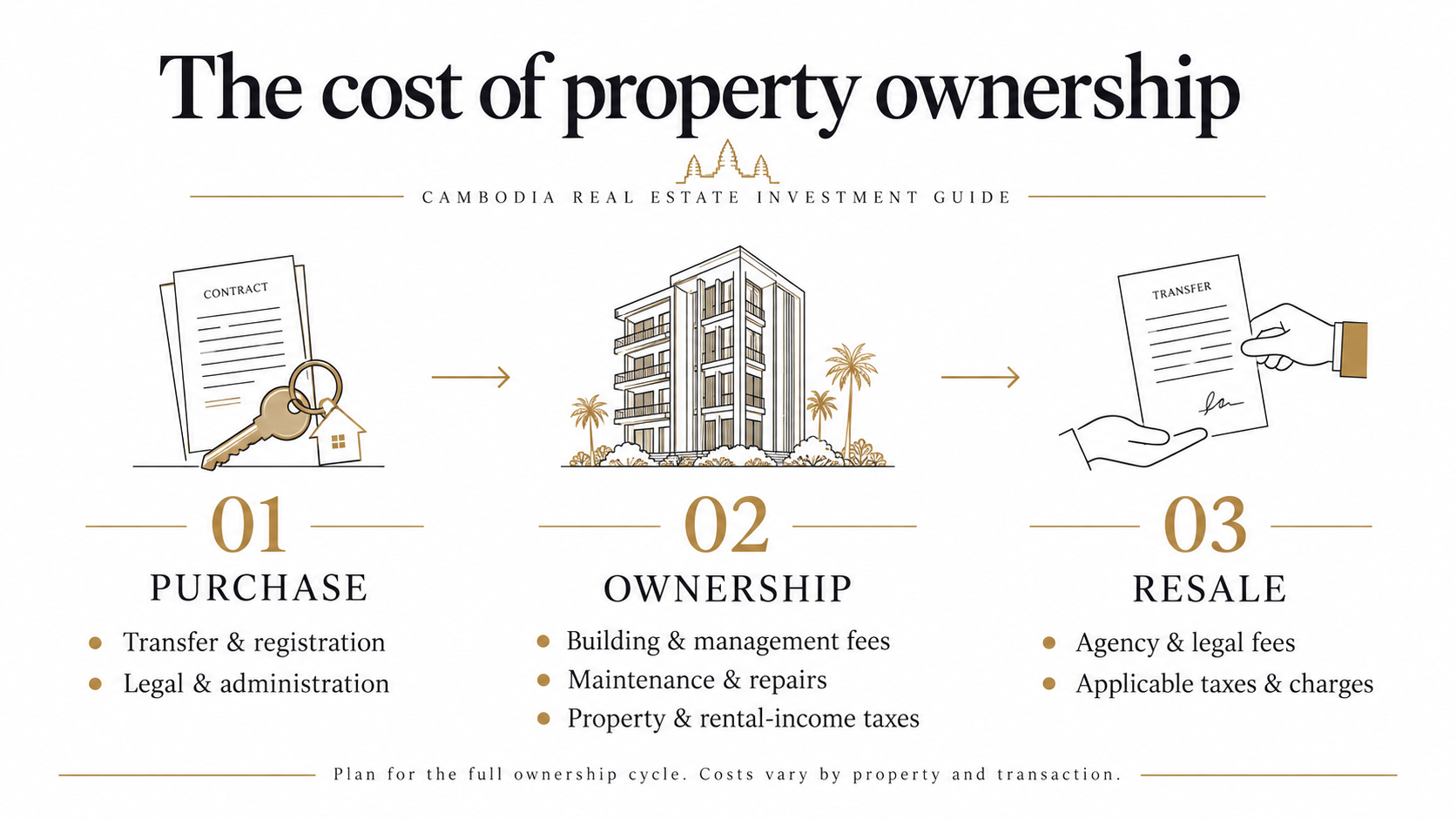
Property investment involves more than the purchase price.
Depending on the property and transaction, investors may encounter costs associated with:
- Property transfer and registration
- Legal or administrative procedures
- Property management
- Building management and common-area fees
- Repairs and maintenance
- Property-related taxes
- Tax on rental income
- Resale-related expenses
The exact amount varies by property, ownership structure and current regulation.
Investors should therefore request a full estimate of acquisition and ongoing costs before purchasing and calculate expected returns on a net rather than purely gross basis.
Best Areas for Property Investment in Phnom Penh
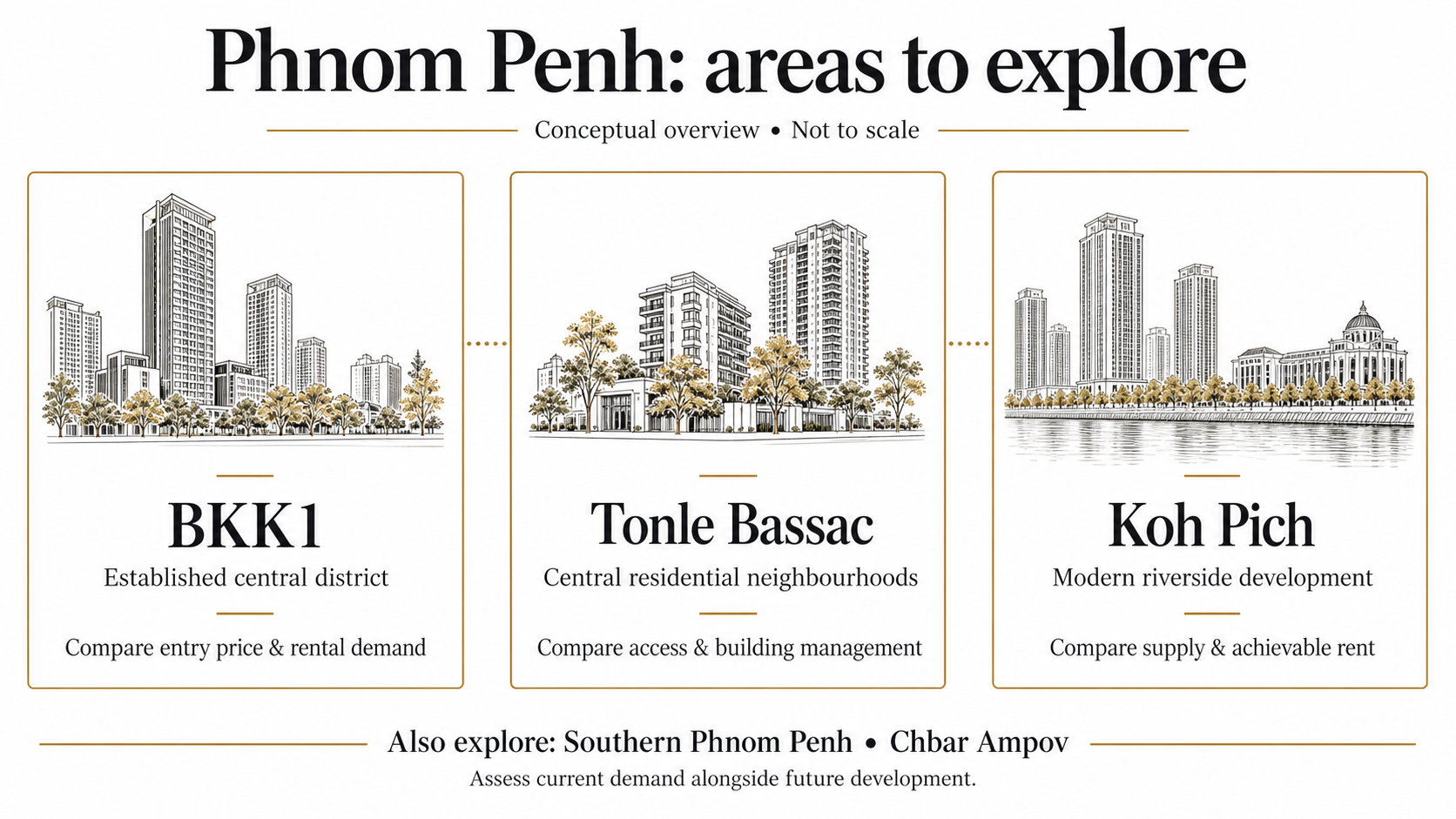
Location remains one of the most important factors in Phnom Penh real estate.
The following areas are among the districts frequently considered by condominium investors.
1. BKK1: One of Phnom Penh’s Most Established Prime Districts
BKK1 is one of Phnom Penh’s best-known central residential and commercial districts.
The area contains restaurants, cafés, offices, international businesses and high-end residential properties.
It is also popular with expatriates and higher-income residents, creating an established rental market for quality condominiums.
The strength of the location generally means that property prices are higher than in emerging districts.
Investors should therefore consider not only rental demand but also the acquisition price and achievable yield.
For investors prioritising an established location, leasing demand and resale liquidity over speculative short-term appreciation, BKK1 remains an important area to consider.
2. Tonle Bassac: Central Residential Area with Strong International Demand
Tonle Bassac is located next to BKK1 and is another major residential district in central Phnom Penh.
The area contains embassies, restaurants, commercial facilities and a wide range of condominiums and serviced residences.
Its central location and residential environment make it relevant for both expatriate and family-oriented leasing demand.
Because Tonle Bassac is frequently compared with neighbouring BKK1, investors should compare individual properties rather than relying solely on the reputation of the district.
Purchase price, achievable rent, building management and future competing supply should all be considered.
3. Koh Pich (Diamond Island): Modern Riverside Development
Koh Pich, commonly known as Diamond Island, is a modern development area located along the Bassac River.
The district contains high-rise condominiums, commercial facilities and large-scale urban developments.
Its newer building stock and distinctive riverside environment make it attractive to investors seeking modern condominium projects.
However, investors should also consider competing supply.
The number of residential developments in and around Koh Pich means that building quality, management, unit layout and realistic rental pricing can have a significant impact on performance.
4. Southern Phnom Penh: Long-Term Urban Expansion
Southern Phnom Penh has attracted increasing attention as the city expands along major transport corridors and around Techo International Airport.
Large commercial developments, residential projects and infrastructure investment have contributed to the area’s long-term development story.
However, proximity to new infrastructure does not automatically translate into higher property values.
Investors should examine current residential demand, road access, commercial activity, employment creation and the progress of surrounding developments before making a decision.
Future potential should always be balanced against current market fundamentals.
5. Chbar Ampov: Emerging Eastern Phnom Penh
Chbar Ampov lies east of central Phnom Penh across the river and has experienced continued development alongside improvements to transport infrastructure.
Property prices can be lower than in prime central districts, creating opportunities for investors seeking emerging locations.
However, development and rental demand can vary considerably within the district.
Investors should therefore evaluate the immediate neighbourhood rather than treating Chbar Ampov as one homogeneous investment market.
How to Buy Property in Cambodia: 7 Steps
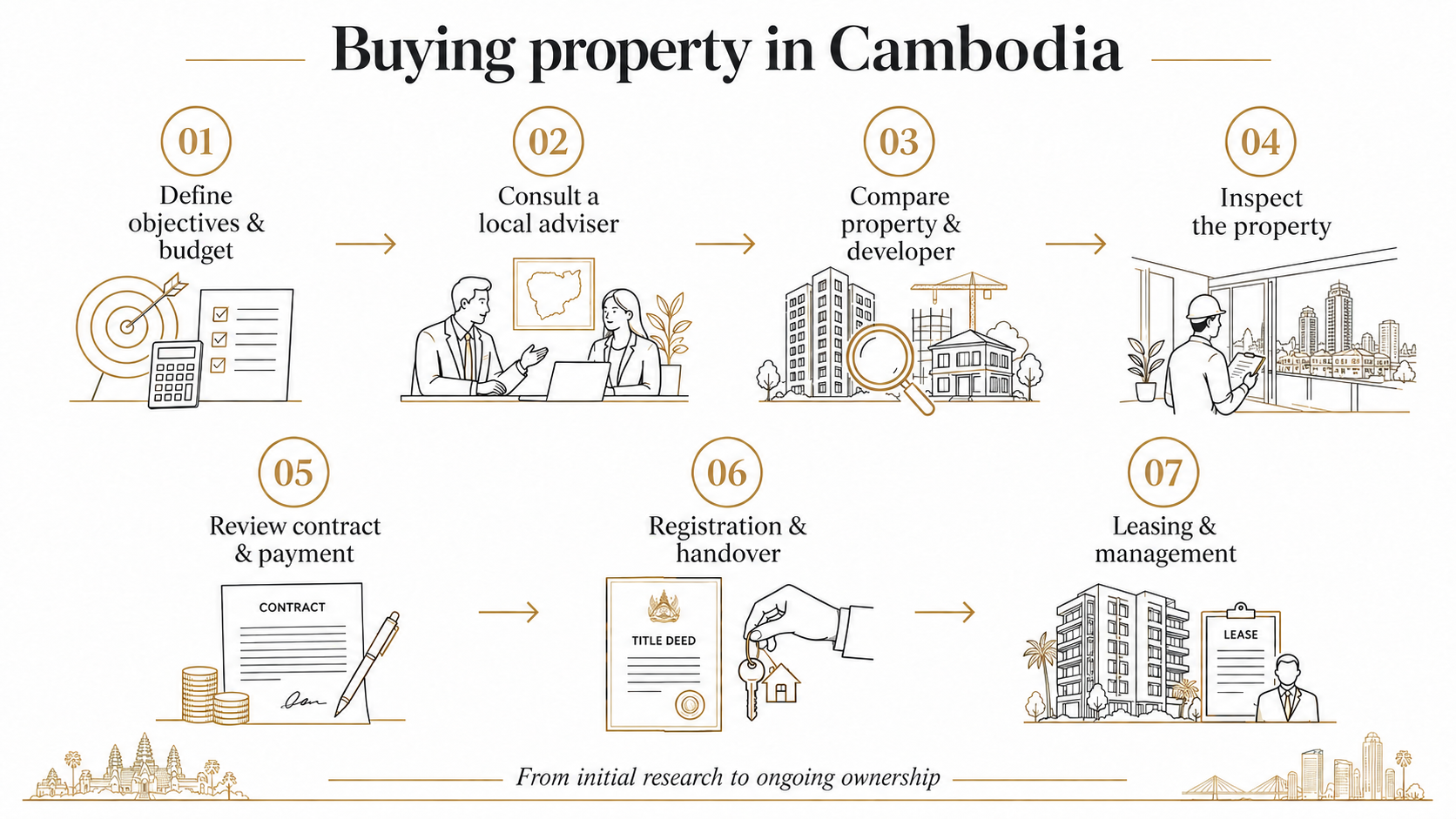
Step 1: Define Your Investment Objective and Budget
Decide what you want the property to achieve.
Are you looking for long-term rental income, capital preservation, portfolio diversification or eventual resale?
Your objective will influence the appropriate location, property type and budget.
Step 2: Consult a Local Real Estate Company
Discuss your budget, investment strategy, preferred areas and risk tolerance with a company that understands the local market.
The objective should be to identify suitable properties rather than simply select from whichever projects are being actively marketed.
Step 3: Compare the Property and Developer
Compare more than the purchase price.
Review:
- Location
- Comparable rents
- Existing and future competing supply
- Building management
- Developer track record
- Construction history
- Unit layout
- Ownership documentation
- Resale potential
Step 4: Inspect the Property and Location
Whenever possible, visit Phnom Penh and inspect the property in person.
For completed buildings, check the actual unit, common areas, maintenance quality and occupancy.
For pre-construction projects, inspect the construction site and surrounding neighbourhood.
The streets, traffic, neighbouring developments and local amenities can reveal information that is difficult to understand from a brochure or online presentation.
Step 5: Review the Contract and Make Payment
Before signing, confirm the purchase price, payment schedule, contractual obligations, cancellation conditions and any additional fees.
International buyers should ensure that the ownership structure and registration process are appropriate for the specific unit.
Step 6: Registration and Handover
For completed properties, registration and handover can proceed after the required payments and documentation have been completed.
For off-plan projects, investors should continue monitoring construction progress until delivery.
Step 7: Begin Leasing and Property Management
For rental investments, tenant sourcing can begin after the property is ready for occupation.
Overseas owners should establish a local management structure capable of handling leasing, rent collection, maintenance and tenant communication.

Phnom Penh Rental Market
Rental prices in Phnom Penh vary substantially according to location, building quality, age, unit size, floor level, facilities and management.
Central areas such as BKK1 and Tonle Bassac generally command higher rents than emerging districts.
However, asking rent alone does not tell investors whether a property is performing successfully.
A more useful metric is the contracted rent: the amount a real tenant has actually agreed to pay.
Investors should compare:
- Current asking rents
- Recent contracted rents
- Vacancy periods
- Competing units
- Tenant profiles
- Building occupancy
- Management quality
This provides a much more realistic picture of rental performance.
Pre-Construction vs Completed New vs Resale Property
Cambodian condominiums can broadly be divided into three categories.
| Factor | Pre-Construction | Completed New | Resale |
|---|---|---|---|
| Physical inspection | Limited | Possible | Possible |
| Initial pricing | Often lower | Generally higher | Varies |
| Immediate leasing | No | Yes | Yes |
| Completion risk | Yes | Minimal | No |
| Rental history | Usually unavailable | Limited | Often available |
| Exit analysis | More uncertain | Easier to assess | Can use market history |
Pre-construction properties may provide attractive entry terms, but investors accept construction and delivery risk.
Completed properties allow buyers to inspect the actual building before committing capital.
Resale properties can provide additional visibility because rental performance, building management and market demand may already be observable.
There is no universally superior category.
The appropriate choice depends on the investor’s objectives, risk tolerance and investment horizon.
Five Common Mistakes When Investing in Cambodia Real Estate
1. Underestimating Completion Risk
Buying off-plan without investigating the developer’s ability to complete the project can expose investors to significant risk.
Investors should verify previous completed developments, construction progress and contractual protections rather than relying solely on brand recognition.
2. Focusing on Projected Yield Instead of Rental Demand
A projected yield is meaningless if the property cannot secure a tenant at the assumed rent.
Before buying, investors should identify who is realistically expected to rent the unit and what comparable properties are actually achieving.
3. Trusting Aggressive Sales Claims
Statements promising guaranteed appreciation or unusually high returns should be treated cautiously.
A reliable adviser should explain both the strengths and weaknesses of an investment.
4. Failing to Understand Local Regulations
Foreign ownership restrictions, title registration, taxation and other legal requirements should be understood before entering into a transaction.
Regulations can also change, making current professional advice important.
5. Buying Without an Exit Strategy
The question should not only be:
“Should I buy this property?”
Investors should also ask:
“Who is likely to buy it from me in the future?”
Resale liquidity can be more limited in emerging property markets.
Before purchasing, consider the likely future buyer, realistic resale price range, holding period and circumstances under which the property would be sold.
A clear exit strategy should form part of the investment decision from the beginning.
Where to Find Cambodia Property Information
Reliable information can be more difficult to obtain in an emerging real estate market than in highly developed markets.
Investors should compare multiple sources rather than relying on a single property advertisement.
Useful sources include local real estate company listings, market reports, property portals, developer information and direct observations from the leasing market.
Anna Advisors also provides an online property search service where international investors can browse properties by area, price range, property type, layout and other criteria.
When researching properties online, remember that listing prices and asking rents do not necessarily represent completed transaction prices.
Where possible, confirm current availability and actual market conditions with a local professional.
Frequently Asked Questions About Cambodia Real Estate Investment
Can foreigners buy property in Cambodia?
Yes, subject to certain restrictions.
Foreign nationals generally cannot directly own land in Cambodia, but qualifying condominium units can be owned under foreign ownership rules.
Before purchasing, confirm that the specific unit is legally eligible for foreign registration.
Can I invest without living in Cambodia?
Yes.
Many international investors purchase Cambodian property without becoming Cambodian residents.
If the property is intended for rental, however, reliable local management becomes particularly important.
An overseas owner needs someone on the ground to handle tenants, maintenance, payments, building management and other operational issues.
Is property in Cambodia cheap?
Property can be relatively affordable compared with major regional cities, but not every property in Cambodia is inexpensive.
Prime condominiums in central Phnom Penh can command substantial prices.
Investors should compare price per square metre, achievable rent, net yield, management quality and resale prospects rather than judging an investment purely by the total purchase price.
Is a more expensive condominium always a better investment?
No.
Premium properties may benefit from better locations, facilities and management, but an excessively high acquisition price can reduce investment returns.
Likewise, a cheap property is not necessarily attractive if there is little rental or resale demand.
The objective is to find an appropriate balance between price, income potential, location and long-term marketability.
Who typically invests in Cambodian property?
Cambodia attracts a range of international investors, including buyers seeking geographic diversification, USD-denominated real estate exposure and long-term participation in an emerging Southeast Asian economy.
However, the market may not be suitable for investors who require guaranteed principal protection or guaranteed short-term appreciation.
Can foreigners buy property outside Phnom Penh?
Potentially, provided the property satisfies foreign ownership requirements.
However, legal eligibility is only one part of the investment decision.
Rental demand, property management availability and resale liquidity can become more challenging outside major urban markets.
For investment purposes, these factors should be evaluated carefully.
Should I inspect the property in person?
Whenever possible, yes.
Photographs, renderings and virtual tours cannot always show traffic conditions, neighbouring developments, local amenities, building maintenance or the overall character of an area.
For substantial investments, visiting the property and surrounding neighbourhood can significantly improve the quality of the investment decision.
What happens after I buy a property?
Investment property requires ongoing management.
This can include tenant sourcing, rent collection, maintenance, repairs, contract renewals, tax administration and communication with building management.
Investors should also periodically review market rents, competing properties and resale conditions to decide whether continuing to hold the asset remains the best strategy.
The quality of post-purchase management can have a significant impact on the long-term performance of an overseas property investment.
Conclusion: Invest Based on Real Market Fundamentals
Cambodia real estate offers characteristics that can be attractive to international investors, including USD-denominated transactions, relatively accessible condominium prices and exposure to a developing Southeast Asian economy.
However, the Phnom Penh property market should not be approached on the assumption that prices will automatically rise.
Investors need to consider construction risk, condominium supply, actual rental demand, legal requirements, property management and eventual resale liquidity.
The strongest investment decisions are therefore based not only on the purchase price or projected yield, but on a broader question:
Does this property have a realistic reason to remain attractive to tenants and future buyers?
Anna Advisors is based in Phnom Penh and supports international property investors throughout the ownership cycle, from property selection and acquisition to leasing, property management and eventual resale.
Our local team works directly with the Phnom Penh market, allowing us to evaluate properties not only from a sales perspective, but also through actual leasing conditions, management requirements and resale considerations.
If you are considering purchasing property in Phnom Penh, contact Anna Advisors to discuss your investment objectives and explore properties suited to your strategy.
Plan your next step in Phnom Penh.
Discuss your budget, preferred areas and investment objectives with our local team.